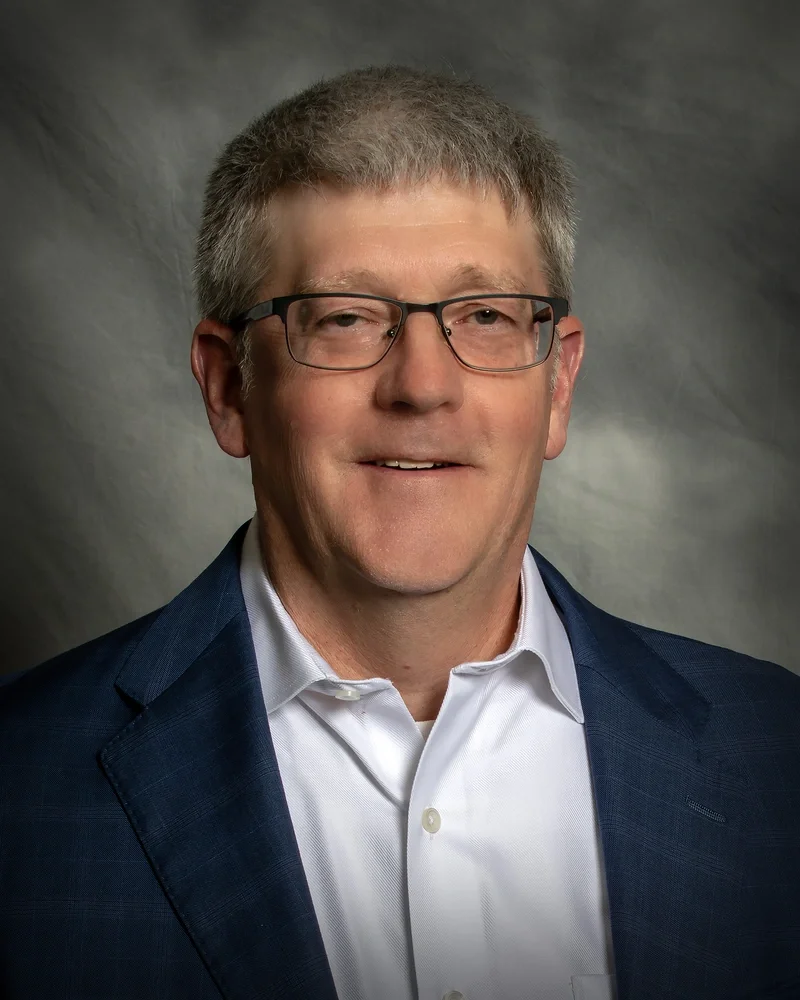
After finishing his Ph.D. in chemistry at MIT, Illinois alumnus David Hays (B.S., ’93) was entering a particularly strong job market for chemists, exploring a lot of companies and industries in interviews. Enticed by the freedom to follow his curiosity and explore a huge array of technologies and markets, he accepted a job at 3M.
Nearly 28 years later, Hays is still pursuing his scientific curiosity as a Senior Staff Scientist in the Corporate Research Materials Lab at 3M and was just elected to the National Academy of Engineering "for materials and manufacturing process discoveries in pharmaceuticals, optical films, specialty adhesives, and biopharma purification membranes." Hays also received the highest recognition of lifetime achievement for 3M scientists and engineers when he was recently inducted into The Carlton Society at 3M.
Hays relishes his work—from his very first 3M assignment elucidating the mechanism of how and why a newly discovered structural adhesive worked so well to his current work on synthesizing new materials for membrane separations.
“The day-to-day enjoyment we all experience as chemists hasn’t faded either,” said Hays, who ranks time in the lab as an undergraduate researcher among his best memories as a student at Illinois. “Working in the lab and experiencing the euphoria for the first time when I made discoveries, whether big or small, that’s the feeling that set me on this career path and never gets old.”
Hays said he always knew he wanted to work in a technical role and 3M’s dual career ladder, meaning that you can choose to grow your career by staying technical or by entering the management ranks, has allowed him to expand his leadership while also working in the lab where he can continue innovating.
“Opening that perfect NMR spectrum, seeing a new reaction or polymerization work as you had hoped, or the ‘eureka moments’ of getting data that reshape how you think about technologies. It’s about the steady progression of a technology, from inception to manufacturing to product sales that is unlike any other career gratification I had imagined,” he said. “And I can go to stores and buy products with my chemistry on it, and that is very cool.”
The Carlton Award at 3M acknowledges that growth and diversification originate at the bench and its purpose is to encourage innovation and perseverance in research and product and technology development. Hays was inducted as “a 3M materials expert who has applied the fundamentals of chemistry to successfully invent, validate, scale, and commercialize new-to-3M polymer classes. These efforts are exemplified by a unique class of silicone elastomers impacting multiple product platforms.”
In the company’s 119-year history, only 210 employees have been inducted into The Carlton Society, which involves a lengthy nomination process and requires a team of peers to document your entire career. Then it’s validated and voted on by high-level leadership throughout the company.
With around 4,000+ technical employees at 3M, the odds of receiving the honor are extraordinarily low.
“Squaring those statistics with the reality of having received it is mind blowing,” Hays said. “I’m tremendously grateful to the team of folks who took the time to champion this on my behalf.”
An Ohio native, Hays was surrounded by science and technology through the interests and hobbies of his father, an engineer who graduated from Illinois in 1965. As a self-described engineering-leaning chemist, Hays said that being elected to the NAE is even more special, because of his father's influence. His mother is also an Illinois alum who graduated in 1965 with a degree in education. Hays said his mother greatly influenced his appreciation for learning.
Intending to follow in his father’s footsteps and become an engineer, Hays chose Illinois as an undergraduate, because it was one of the best engineering schools in the nation. When he took a general chemistry course taught by Steven S. Zumdahl, now professor emeritus of chemistry, those plans changed.
“I was hooked, and I switched my major to chemistry. Of course, Illinois is also among the best chemistry schools in the country,” said Hays, who described Zumdahl’s course as legendary.
“The lectures were riveting, technically deep, and understandable. What’s amazing is that nearly every chemistry concept I’ve encountered in my career was in some way touched upon in those classes. Truly foundational,” Hays said. “Professor Zumdahl was also a great mentor to me and helped shape my trajectory in the field.”
Later, Hays took an organic chemistry lecture class taught by Professor Scott Denmark.
“It was a difficult class, but I must have done well enough, because he invited me to do research in his lab,” Hays said. “I was fortunate to get the full experience of life in a top synthetic group: I had my own fume hood and equipment, attended group meetings, and provided regular report-outs, with no room for error. His expectations were high, but he pushed me to be my best. His emphasis on rigor and completeness has served me well in my career.”
Hays also recalls his organic synthesis lab taught by the late Professor Peter Beak.
“In nearly every session, he would emphasize how organic chemists need to get good at ‘reasoning by analogy.’ I didn’t fully appreciate this until much later in my professional career, but now I reference it in my own [presentation] slides,” Hays said.
Hays also fondly remembers the late Rebecca Simon, an academic advisor and director of the Advising Office in the School of Chemical Sciences, who helped him “with everything” including on the job experience for several semesters at Eastman Kodak through the Cooperative Education Program.
“The program allowed me to get extensive industrial research experience on meaningful projects, and it shaped my thinking on pursuing a professional career in materials chemistry,” Hays said. “Becky was an absolute treasure, and it’s so special to see her legacy celebrated in the Rebecca J. Simon Professional Development Award and the Rebecca J. Simon Memorial Fund.”
Jeffrey Moore, Stanley O. Ikenberry Research Professor in Chemistry at Illinois, was a faculty mentor when Hays was a student. Moore said Hays is widely recognized as a leading expert in materials chemistry, with contributions that span pharmaceuticals, optical films, specialty adhesives, and release liners.
“His groundbreaking work has led to the discovery of fundamentally new molecules and materials and the mastery of their complex manufacturing processes,” said Moore, who added that the significance of his achievements is also reflected in Hays receiving the prestigious ACS National Award in Industrial Chemistry in 2021. He said Hays has a rare ability to blend technical excellence with a commitment to advancing innovation and collaboration, both internally at 3M and across the broader scientific community.
After his first 3M assignment in the Adhesive Technologies Center, Hays worked on a program to develop novel conjugated polymers for rapid pathogen detection. In 2002, he moved to the 3M Pharmaceuticals Division as a medicinal chemist, working to expand upon a new class of drugs called Immune Response Modifiers (IRMs) that had been discovered at 3M by the chemist John Gerster and the biologist Richard Miller.
“We made some impactful discoveries in new Toll-Like Receptor Agonists,” Hays said.
After 3M divested its pharmaceutical business, Hays joined the optical film business during an exciting time when the flat panel display revolution was underway in cell phones, TVs, tablets, and more. 3M had developed a technology to manage light in new ways using films containing stacks of hundreds of polymeric layers—only 100 nanometers thick—that need just the right optical properties.
“It was a ripe area for new materials development, and we identified a novel class of polymers with exciting performance. Optical polymers are extremely high-grade materials that must be clear, colorless, and defect-free. In some ways, optical polymers are more synthetically challenging than small molecule drug molecules,” Hays said.
In 2008, he moved to 3M’s chemical manufacturing organization to develop a process for the scale-up and manufacture of the new materials. And in 2020, Hays moved back to the Corporate Research Labs, where he is today working on synthesizing new materials for membrane separations.
Hays also gets outside the lab, delivering technical seminars and instructional courses across the country, including universities. He is also active in the 3M Tech Forum, which is a self-directed, grassroots technical group established to share ideas and knowledge across the R&D enterprise with 30 chapters spanning the technologies of most importance to the corporation. Through the forum, Hays said he has built relationships with faculty at the forefront of their fields. And he devotes a lot of time to mentoring and recruiting at 3M. Through Technical Aide and Internship programs, Hays has supervised many undergraduate and graduate students.
“At a technology company like ours, staying connected to students and universities is critical, both in terms of mentoring the next generation of scientists and staying close to the latest research,” he said. “I’ve always viewed recruiting as one of the most impactful things we can do to ensure long term success, and I’ve spent a lot of time on it over the years. Visiting universities and interviewing many talented candidates is incredibly energizing. I often say that I’m not searching for new employees, but rather future Carlton Society members.”
Q&A with David Hays (B.S., ’93)
How has your education at the University of Illinois impacted you? Illinois Chemistry is such a storied institution. I realized that when I was a student there, but over the years and on a personal level, having been a part of it is a real source of pride. The complete educational experience, the research opportunities, and the mentorship I received prepared me for graduate school, and ultimately for a career at 3M.
Share some lasting memories from your time as a student at Illinois.
I remember arriving at Illinois as a freshman and being impressed by how talented and driven my classmates were, first in Engineering, and then in Chemistry. Everyone worked super hard, and I spent a lot of time in the study carrels. Illinois basketball and football games were a blast, and they offered a nice break from schoolwork, even if it meant walking in terrible winter weather to the stadiums on occasion!
What advice would you give current undergraduate/graduate students in chemistry at Illinois?
For undergraduate students, my advice is to do as much hands-on research as you possibly can. Doing the chemistry that you learn about in classes adds an entire dimension to your understanding. Research also helps you understand what you like and don’t like, and you’re more informed later, when choosing a graduate school or a career path. With all the opportunities for students at Illinois, think of it like an immersion experience: surround yourself by the content, the people, and the culture. The same goes for graduate students. The department is incredibly well resourced, and the faculty are world-class. The seminar series brings in speakers who are the best-of-the-best. Value this uniqueness and take complete advantage of it.