Prof. Eric Oldfield has thought about retiring—more than once—but his curiosity continues leading him in new directions to new research projects.
“I don't really understand the concept of retiring,” said Oldfield, who just began his 51st year as a chemistry professor at Illinois.
He is one of only a handful of current Illinois faculty members and staff beyond the 50-year mark and the first faculty member in chemistry to surpass a half century as professor. In the thick of some potentially impactful drug-related research, Oldfield has no immediate plans to retire.
“The good thing about this job is they pay you to do what you'd pay to do,” said Oldfield, who explained that he got a head-start on his career because he got his Ph.D. in the UK, where students finish much earlier than in the US, so can get into a faculty position sooner.
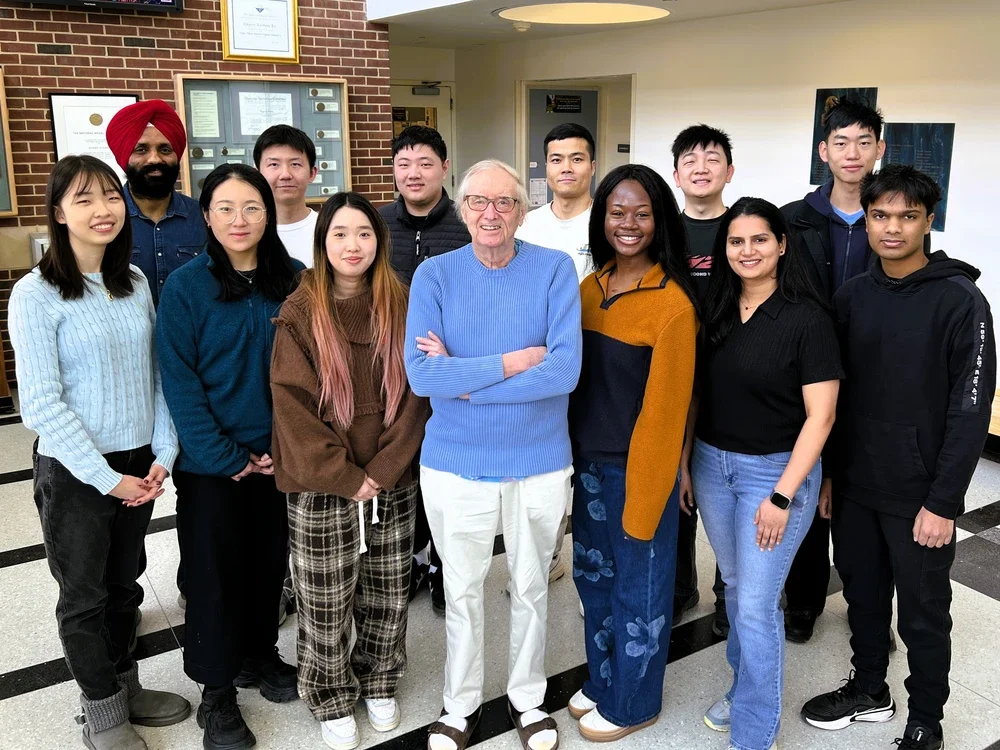
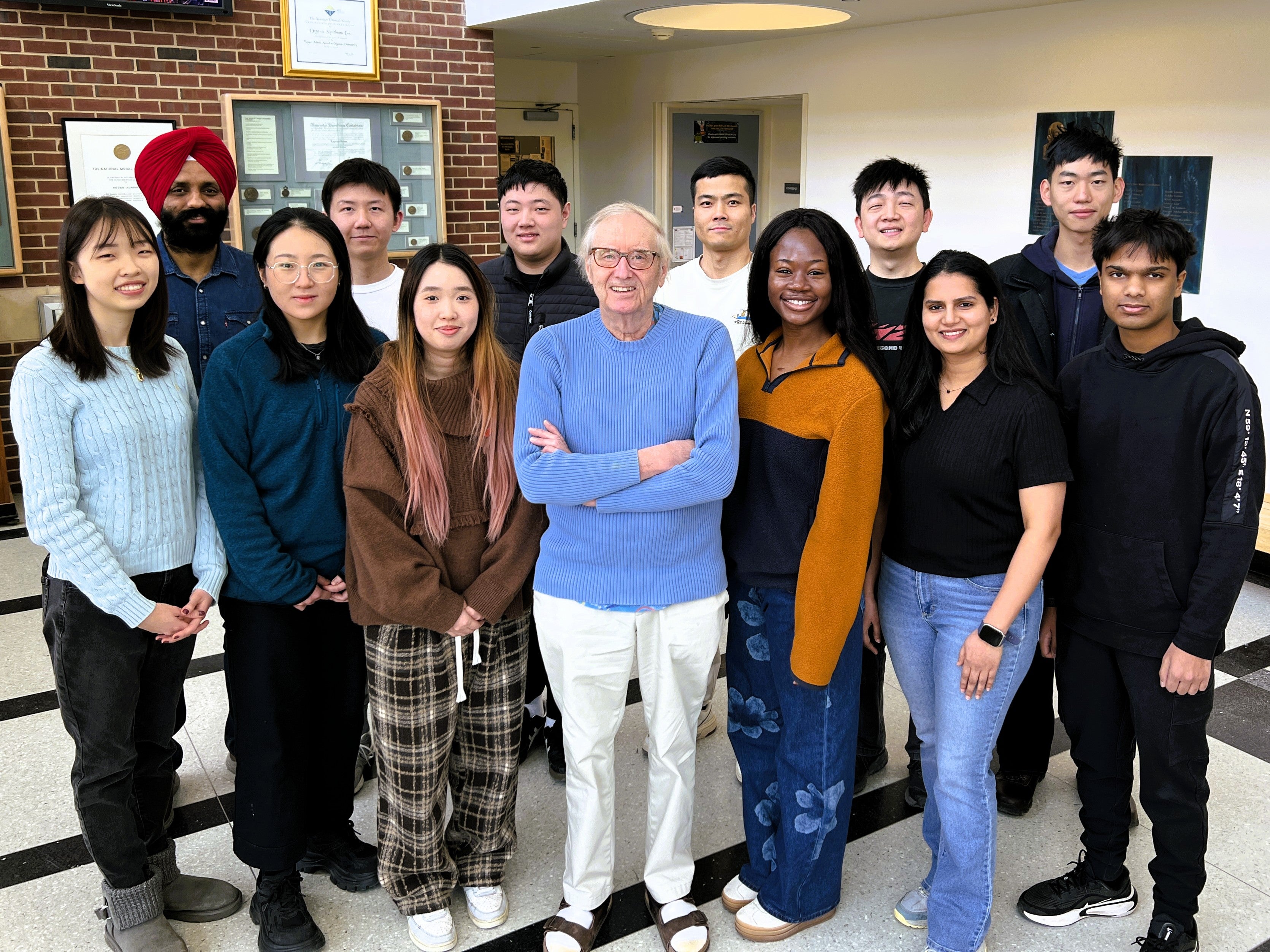
The spry 77-year-old still teaches a physical chemistry lab course every semester and leads a research group of five postdocs and ten undergraduates. Using x-ray diffraction, computational chemistry, nuclear magnetic resonance, and synthesis methods, his group is currently developing new antibiotics, anti-parasite drugs, and anti-cancer drugs. The group just published a paper in February about their latest research exploring the potential of drugs designed to reduce bone loss, treat osteoporosis, and manage metastases could be good candidates for antifungal drug leads.
And just last year, Oldfield was part of an international team of scientists who received the Chemistry Biology Interface Horizon Prize from the Royal Society of Chemistry for developing a comparative lipidomics platform, combining chemical synthesis, bioinformatics, and human immunology with the aim to fight tuberculosis and other infectious diseases.
Department Head and Professor Catherine J. Murphy said Professor Oldfield is a remarkably dynamic scientist.
“He has reinvented his research program at least eight times, making seminal contributions in diverse fields: NMR of membranes, proteins, and inorganic solids; fuel cell catalysis; quantum chemistry; high-temperature superconductors; and the development of anti-parasitic, anti-bacterial, anti-cancer, and anti-fungal drug leads,” Murphy said.
An Illinois alum, Murphy graduated with a bachelor’s degree in chemistry in 1986 when Oldfield was just a decade into his career as a faculty member in the Department of Chemistry. He was already enjoying exceptional and early success, Murphy said.
Oldfield had just received the American Chemical Society's Award in Pure Chemistry, an honor bestowed upon only three Illinois faculty in the 94-year history of the award. A year prior, he received the Biochemical Society's Colworth Medal as "the most promising Biochemist." And before that, he was awarded the Royal Society of Chemistry's Meldola Medal and Prize, awarded to the top young British Chemist, marking the only time it was awarded to a scientist working outside the UK.
The first half of his distinguished research career focused on nuclear magnetic resonance spectroscopy of unusual nuclei; Murphy remembers hearing, as an undergraduate researcher in professor Tom Rauchfuss’ lab, that Oldfield was investigating 17O NMR spectroscopy of the then-new yttrium barium copper oxide superconductors. In 2000, a collaboration with Professor Julio Urbina, a former graduate-era colleague at Sheffield and MIT, led him in a new direction – infectious diseases.
Their collaboration with professors Roberto Docampo and Silvia Moreno in Veterinary Medicine at Illinois, led to the breakthrough discovery that enzymes in the parasitic protozoa that cause diseases such as malaria, toxoplasmosis, and Chagas disease, could be targeted by bisphosphonate drugs such as Fosamax, used to treat osteoporosis. That work led to the synthesis of more active molecules and an important discovery of a pathway in protozoa, yeasts, and fungi that gives them potent antiparasitic and anti-fungal properties. They also learned that these compounds target tumor cells by activating unique immune cells, called gamma-delta T cells, that can stimulate an innate immune response in the body.
His group’s most recently published papers demonstrate that the tuberculosis drug, SQ109, also have potential to fight fungi that cause infections, as do the derivatives of the bisphosphonate drugs. In total, Oldfield has published more than 450 papers that have amassed more than 39,000 citations.
About 10 years ago, Oldfield shifted away from bringing more graduate students into his group and focused solely on undergraduates. At the time, he said, he was not sure his projects would sustain a five-year commitment to funding graduate students. So, he restructured his group with experienced postdoctoral researchers who help train and lead undergraduates in research projects.
Oldfield has mentored more than 130 undergraduates throughout his career. They have been co-authors on more than 70 publications. Fellow chemistry faculty members said Oldfield has a knack for recruiting exceptionally talented undergraduates to his group.
“I've always had lots of undergraduates. I used to have postdocs and graduate students supervising undergraduates, and now the postdocs supervise undergraduates,” said Oldfield, who believes diversity and inclusive culture are among the greatest strengths of his group. “My belief is that providing equal access to opportunities and resources fosters an environment where all individuals feel valued, respected, and have a sense of belonging. This inclusive culture is, I believe, a key reason so many talented undergraduates have joined my lab: the diversity in my group has always been one of its greatest strengths.”
Akanksha M. Pandey, a postdoctoral research associate in the lab, said working with Prof. Oldfield has been a life-changing experience. She said she aspires to a research career in either industry or academia, and her career goals have evolved under Prof. Oldfield’s mentorship, which has inspired her to lead high-level research.
“He is a wonderful person whose passion for science is contagious, and I am constantly amazed by his encyclopedic memory and depth of knowledge. His genuine kindness inspires me daily, and he has truly transformed my interest in research into a lifelong love for science," Pandey said.
Ronna Li, a chemistry, and psychology major in the Class of 2027, said she was genuinely welcomed into the Oldfield lab as an undergraduate researcher despite her lack of experience. When she first reached out to Prof. Oldfield, she said he replied within a day, shared papers and recorded talks related to the project, added a lighthearted emoji, and told her she could start whenever she was ready.
“In his lab, accuracy clearly matters more than speed, and mistakes are discussed openly rather than hidden. I never felt embarrassed admitting an error, even when it meant discarding days of work, because the expectation is that learning is part of doing science well,” she said. “Professor Oldfield is also memorably hands-on. If you knock on his office door with a question, he’ll pull out a marker and sketch pathways from memory. If an instrument isn’t behaving, he’ll come to the lab and show you how to think through the problem. He has a habit of sending early-morning emails sharing a new paper or an odd observation he finds exciting.”
Murphy said Oldfield’s profound impact on his students' intellectual development is evident in their opportunities after graduation with many pursuing MD or PhD degrees at top-tier institutions such as Harvard Medical School, MIT, Berkeley, Yale Medical School, the Mayo Clinic, NYU Grossman School of Medicine, Northwestern University Feinberg School of Medicine, and the Washington University School of Medicine in St. Louis.
Many of his undergrads and graduate students also work in industry. His first undergraduate student Gary Turner (B.S., '78) went on to earn a PhD and returned to Illinois to do postdoc work for Oldfield and Illinois geology professor James Kirkpatrick. Together, they co-founded a commercial NMR testing company, Spectral Data Services. The Champaign company is now in its 41st year of operation and Turner is president.
Oldfield shared that Yonghui Zhang, who was a postdoc in his lab more than 20 years ago, is now a professor at Tsinghua University in Beijing, China’ s top school, where he works on antimalaria and anticancer drugs, work that was started at Illinois. Zhang also runs a company developing new cancer therapeutics.
Former graduate student Weixue Wang (Ph.D., '12) investigated enzyme mechanisms with Oldfield and continued that research at MIT. In 2022, he was named one of C&EN’s Talented Twelve, for developing novel kinase inhibitors, anti-cancer drugs.
Hye Kyung Timken (Ph.D., '87), after graduate work on NMR and zeolites in Oldfield’s group, continued that work at Mobil and moved to Chevron where she developed the first commercial ISOALKY™ Alkylation Plant. Launched in 2021, the plant has substantially decreased risks associated with gasoline production while providing more efficient conversion of petroleum to fuels. She won the U.S. National Academy of Sciences Award for Chemistry in Service to Society in 2023, and in 2024 was elected to the National Academy of Engineering.
Oldfield’s impact is also evident in the department’s undergraduate physical chemistry lab curriculum. Several years ago, he spearheaded the overhaul of the p-chem lab courses.
When the pandemic forced the cancellation of all classes and labs in 2020, Oldfield said he had time to re-think the department’s entire Physical Chemistry Laboratory course structure.
“And, with help from staff, I developed a totally revised course structure,” Oldfield said. “The objective was exposing undergraduates to techniques they could use in their current research as well as in their future careers.”
He increased the number of experiments to twelve, and most are entirely new, which meant writing new lab instructions and revising old ones, more than tripling the lab manuals to 680 pages. The new curriculum features innovative experiments, introducing students to techniques that are essential for modern research but are not typically covered in lectures, including Electron Paramagnetic Resonance spectroscopy; Fourier-Transform Infrared spectroscopy; X-ray diffraction; Differential Scanning Calorimetry, and more.
The Department backed his efforts, funding major instrumentation, from state-of-the-art gaming computers for quantum mechanics and MD simulations to a new NMR instrument, an MRI system, and a bomb calorimeter.
“The students now have hands-on experience using high speed computers, and they can carry out advanced multi-dimensional NMR experiments, x-ray crystallography, quantum mechanics calculations, molecular dynamics, enzyme inhibitor assays, and much, much more,” Oldfield said. “I believe we have the best undergraduate Physical Chemistry lab in the US.”
As a former student who took these courses in the eighties, Murphy said the revised curriculum offers students a completely different level of experience.
“It provides our students with one of the best Physical Chemistry Lab experiences available, anywhere,” Murphy said.
Undergraduate research is important, Oldfield said, partly because it was instrumental in his own career path.
“For me, my undergraduate research experience at The University of Bristol was a transformative one in that it made me change my major in my final year, from Biochemistry to Chemistry,” said Oldfield, whose first research experience in the Summer of 1967 was exploring the synthesis of plant growth substances, called gibberellins. Next, he did research on terpenes in an organic geochemist’s lab that was designated a Lunar Receiving Laboratory for the Apollo 11 samples, and in his final year as an undergraduate researcher, he worked on his own projects.
“Without these undergraduate research experiences, I would not be a Professor of Chemistry,” Oldfield said.