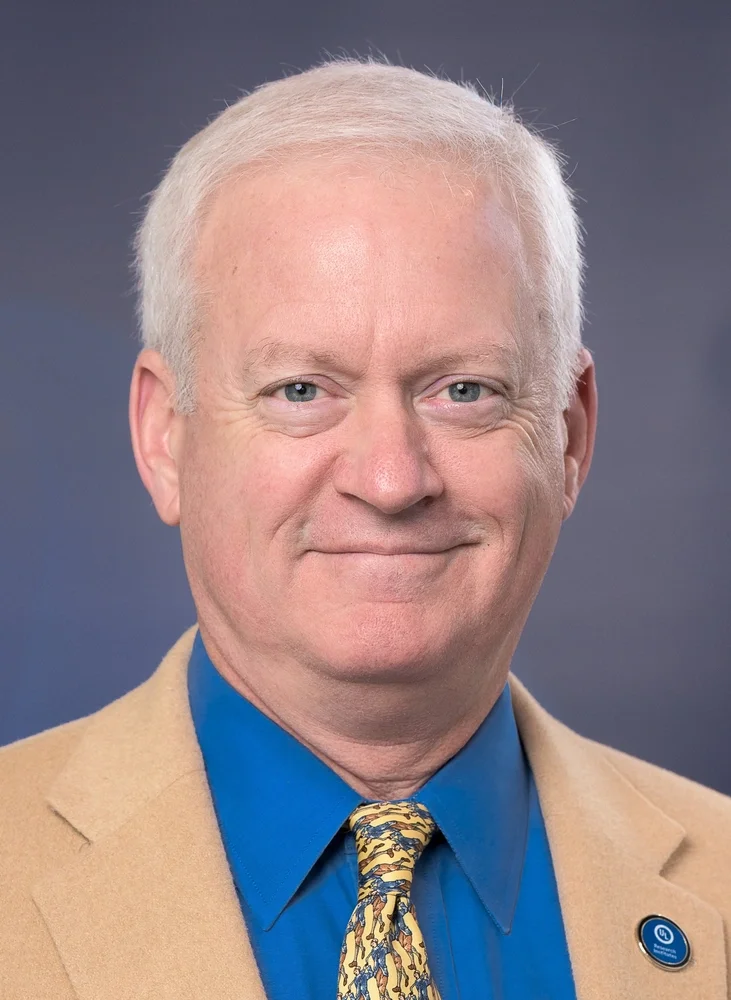
After 30 years as a chemistry professor at the University of Minnesota, Christopher Cramer was thoroughly enjoying his day-to-day mission as Vice President for Research at Minnesota when a tantalizing opportunity emerged in the private sector.
“It was a remarkable opportunity,” said Cramer (Ph.D., ’88), an Illinois chemistry alumnus who accepted the offer to be the inaugural chief research officer for UL Research Institutes.
An independent nonprofit safety-science organization, UL Research Institutes has offices and state-of-the-art facilities around the country where researchers collaborate to rigorously investigate public safety risks and define the safe and sustainable use of materials and emerging technologies.
“We do safety-science research for the public good,” said Cramer, who is based in the UL Research Institute’s Evanston offices.
Six institutes—Chemical Insights, Digital Safety, Electrochemical Safety, Fire Safety, Materials Discovery, and Research Experiences and Education—are dedicated to doing safety-science research that is publicly shared. Some examples of their fire-safety work include investigating the best way to put out an electric vehicle fire and studies commissioned by the states of Hawai'i and California to find ways to prevent future wildfire disasters like those experienced in Maui and southern California.
Since Cramer accepted the opportunity with UL Research Institutes about five years ago, the organization's resources available to fund its work have grown to roughly $15 billion.
“We've built up our capacity faster than I imagined possible. We are still growing ferociously,” said Cramer, who is the keynote speaker at the Department of Chemistry's upcoming Convocation on Sunday, May 17, 2026.
Originally, Cramer was a math major on the pre-med track as an undergraduate at Washington University in St. Louis. He particularly enjoyed his organic chemistry requirement and the professor teaching the course (David Gutsche) invited him to do research in his lab.
“I liked it so much, I decided I would pick up chemistry as a second major,” Cramer said. Eventually, he chose chemistry graduate school over medical school, and chose Illinois chemistry over Harvard, partly to stay in the Midwest for personal reasons.
“Illinois had a fabulous reputation… so it was a combination of a personal situation and then the reputation of the department, and I grew up in the Midwest, so it felt right” he said.
At Illinois in Prof. Scott Denmark’s group, Cramer got very interested in computational chemistry over the course of his doctoral studies. His research focused on physical organic chemistry and synthetic methodology, in particular [4+2] cycloadditions of heterodienes and phosphorus-stabilized allyl anions.
Sharing best memories from graduate school, Cramer said he would share one of his “strongest” memories. Giving a postdoc a ride one winter, he pulled out of a parking lot near RAL, evinced great confidence in being able to ram through a snow berm left by plows in the middle of the street in order to turn left, and ended up beaching his vehicle atop the drift, engine stalled.
“I grew up in Wisconsin. I cut my teeth driving in snow,” said Cramer, recalling all the faces in every window of the building above him laughing at his predicament. “Some friends eventually emerged with shovels, and we dug it out. It was a good lesson in humility.”
Actual “best” memories, Cramer said including playing on the University's ultimate team with a few of his Denmark-group lab mates.
“We would go out almost every day at lunch and throw a disc on the quad. You needed something else to focus on while in graduate school,” he said.
With his doctoral degree finished in 1988, Cramer had to take a detour—to the U.S. Army. An ROTC student at Washington University, Cramer owed 4 years of service.
“There was an interesting little wrinkle to the whole thing,” said Cramer, who was originally told he could have three years to finish his Ph.D., but with some creative paperwork along the way managed to extend that to a more manageable five-year delay.
The newly hooded Dr. Cramer headed to Korea for a regular troop tour with a tank battalion and then to Aberdeen Proving Ground in Maryland where he spent 3.5 years, including a combat stint in Operation Desert Storm, as a captain in the Chemical Corps, the Army branch responsible for defense against the use of chemical, biological, radiological, and nuclear weapons.
In his time at Aberdeen, Cramer learned that the Army had great digital computers.
“I was able to do some remarkable computations,” he said. “I was tempted by the chance to serve as a mission specialist on the space shuttle, but the University of Minnesota made me a very competitive offer.”
After four years, CPT Cramer became Professor Cramer. In the Department of Chemistry at Minnesota, he taught undergraduates and graduate students and led a research group for the next 30 years. A theoretical chemist, he continues to hold the title of Distinguished McKnight and University Teaching Professor Emeritus at Minnesota. He is the author of the textbook “Essentials of Computational Chemistry” and over 500 peer-reviewed scholarly publications, focusing on the areas of energy and catalysis, chemical theory and computation, and environmental and green chemistry. He won university-wide awards for both undergraduate and graduate teaching.
As the 2026 Department of Chemistry Convocation speaker, Cramer said he was most excited about simply sharing the excitement of that moment with the graduates and their loved ones.
“That is the best part of commencement, reveling in the feeling of accomplishment,” he said. “I hope to be able reinforce that and emphasize the potentially bright character of the future.”