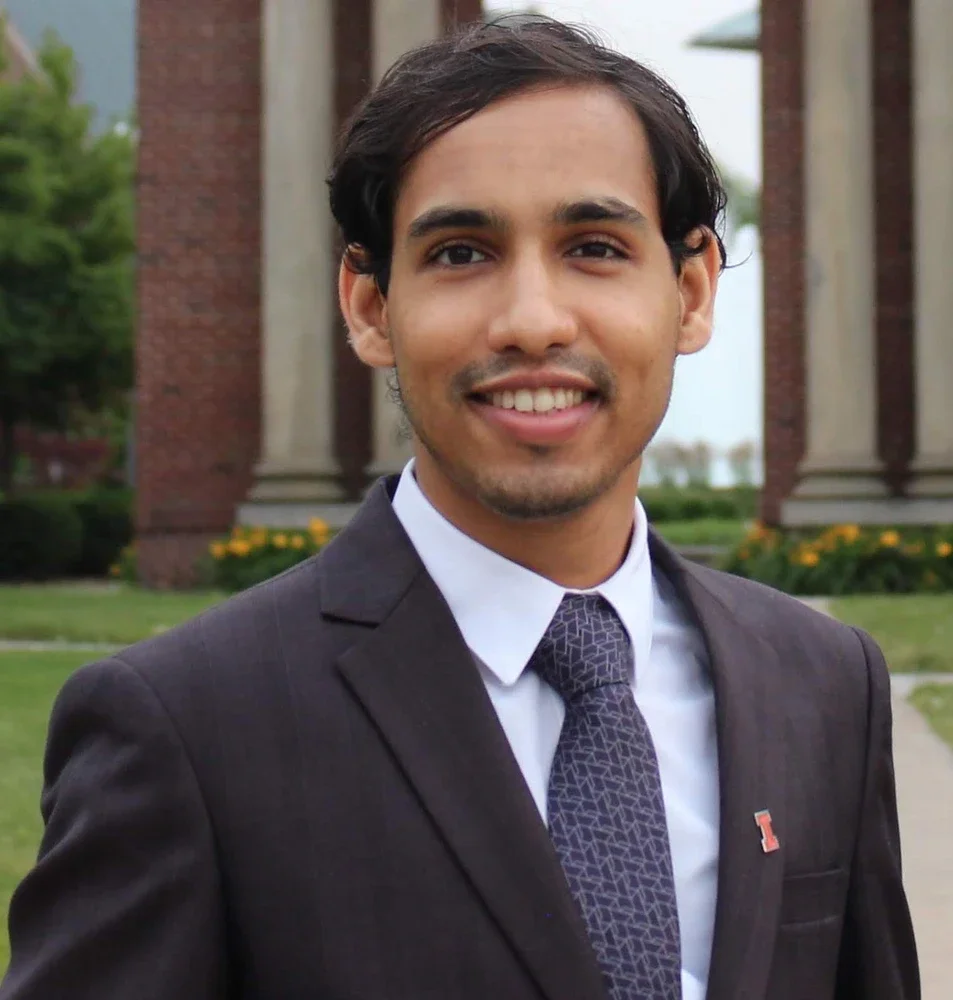
As an Assistant Professor of Chemistry and Biochemistry at the University of California Los Angeles, alumnus Soumitra Athavale (Ph.D., '19) has been working to engineer iron-containing enzymes that could change the way drugs are made by using sustainable and environmentally friendly systems to replace ones that use precious metals, compressed gases, and specialized ligands.
His work was featured in C&EN News, because Athavale was featured as one of the magazine's "Talented 12" for 2026. The annual list highlights young scientists who are making the world a better place through chemistry.
C&EN Talented 12 — Soumitra Athavale: Forging next-generation iron biocatalysts
A native of Pune, India, Soumitra studied chemistry and biology at the Indian Institute of Science Education and Research, Pune, and then came to Illinois to pursue his Ph.D. in molecular and cellular biology. But, according to the C&EN feature, Soumitra decided he wanted to pursue a hardcore organic chemistry thesis project and started cold emailing organic chemistry professors at Illinois to move into a group. He wanted to study the Soai reaction mechanism, which had remained elusive for more than two decades.
Scott Denmark, Reynold C. Fuson Professor of Chemistry, was intrigued and agreed to be his Ph.D. advisor. In the C&EN feature, Denmark said he was blown away during his first meeting with Athavale, because he was fluent in the intricacies and the literature on the Soai reaction.
For 25 years, the Soai reaction has endured as one of the most mysterious reactions in organic chemistry. The work of Denmark and Athavale ultimately shed new light on the strange chemical reaction that’s attracted the attention of scientists for decades. First reported by Japanese chemist Kenso Soai in 1995, the reaction defies belief in multiple ways, and there is no other reaction like it in all of organic chemistry, according to Denmark.
Their research revealed that an enzyme-like mechanism allows tiny chiral imbalances to create single enantiomer products from non-chiral starting materials. Their work was published in Nature Chemistry and featured in an article in Chemistry World.
In 2023, Athavale started his independent career at UCLA, where he is the inaugural John D. and Edith M. Roberts Term Chair in Organic Chemistry.