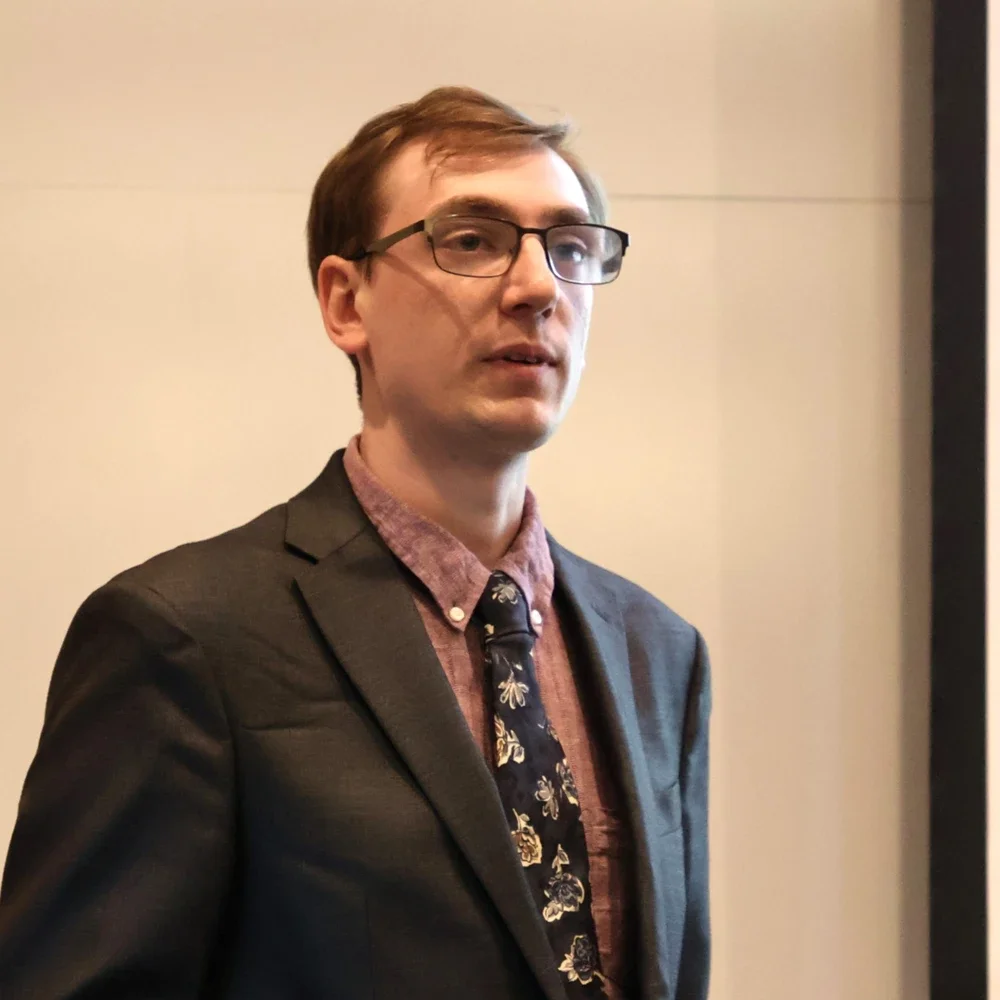
Seth Putnam remembers putting the leads of a 9-volt battery in water and watching the bubbles form from splitting water, one of many simple experiments he did as a kid with his grandfather, Bradford Mundy, an organic chemistry professor at Montana State University.
Still experimenting with electricity as a graduate student in chemistry, Putnam has focused his thesis work in the field of electrochemistry on the study of radicals—species that can react very rapidly and initiate very energetic reactions due to their unpaired electrons. Despite their importance in many electrochemical processes, these radicals are rarely observed or quantified, because they are often extremely short-lived. Putnam’s thesis has been largely devoted to developing new methods to detect and quantify radicals within electrochemical systems.
“If we had a better idea of the radical intermediates involved in important reactions relevant to things such as organic electrosynthesis, fuel cells, electrocatalysis, or batteries, we could rationally design better catalysts and devices,” said Putnam, whose advisor is Prof. Joaquín Rodríguez-López.
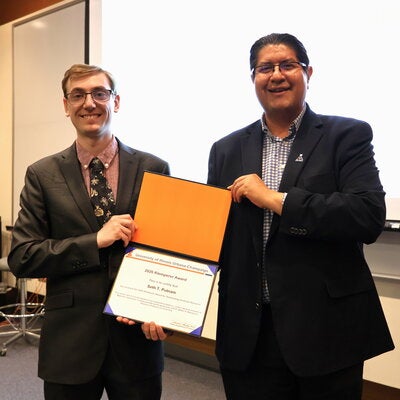
Putnam successfully defended his thesis in March and was selected to receive the 2026 Klemperer Award for Outstanding Materials Chemistry Thesis in the Department of Chemistry.
Putnam said the biggest role model in his life was his grandfather.
“He is definitely responsible for kickstarting my love of science in general,” Putnam said. “He encouraged me throughout my studies to keep going, and my thesis is dedicated to him.”
As the 2026 Walter Klemperer Award recipient, Putnam presented his research to the Department of Chemistry on May 14. He talked about his primary method for detecting radicals using a probe molecule (called DMPO) to capture short lived radicals before they disappear and using a second electrochemical probe to measure the new DMPO + radical species.
“We can do this method within our scanning electrochemical microscopy setup, so we can quantify radicals at the surface of a working electrode, with high spatial and temporal resolution,” said Putnam, who has applied this method to a few systems, most notably measuring hydroxyl radicals generated during the cathodic reaction at a hydrogen fuel cell catalyst and measuring sulfate radicals which are commonly generated by electrochemistry for treating wastewater or synthesizing other molecules.
During his graduate studies, Putnam said he had the opportunity to present his research at a variety of cool conferences. He described the Scanning Electrochemical Microscopy Workshop in Montreal in 2023 as his favorite and his most impactful conference experience.
“This niche international conference is a major one within our field. I had read so many of the papers of the attendees. Getting to interact with them and see the cutting edge of the field and share my work with them and receive feedback and compliments on the work I was doing was deeply inspiring,” Putnam said.
He also said his experience in the Rodríguez-López group made his Ph.D. experience special.
“Joaquín gave me the freedom and space to pursue my interests within the lab, and the group has a great environment where everyone feels enabled to collaborate and share and learn from each other. I learned a lot of chemistry from my peers, but also a lot about the world and their backgrounds. It's a diverse, energetic group,” he said.
This summer, Putnam and his wife, Jamie Berry Putnam, who graduated from Illinois Chemistry with her master’s degree in 2023, will be moving to Washington state where Seth will start in August as a Linus Pauling Distinguished Postdoctoral Fellow at Pacific Northwest National Laboratory. Working at a National Laboratory has been his goal for a while.
“And especially getting to work at one close to where my wife and I grew up in Montana is really ideal,” he said.
The Putnams met in high school and got engaged in the summer between graduating from Montana State University and starting the graduate program in Chemistry at Illinois. They got married in 2023. That same year, Jamie began a second master’s degree program at Illinois in curriculum and instruction with a focus in STEM education and worked for the Worldwide Youth in STEM office in the College of Engineering. She graduated with her second Master's degree in May and she's exploring STEM related jobs in Washington.
Putnam said he was very honored to receive the Klemperer Award.
“I have known in various capacities many of the past winners of this award. All of them were exceptional chemists and extremely accomplished scientists and students. To share this award with them makes me feel flattered and privileged,” he said.