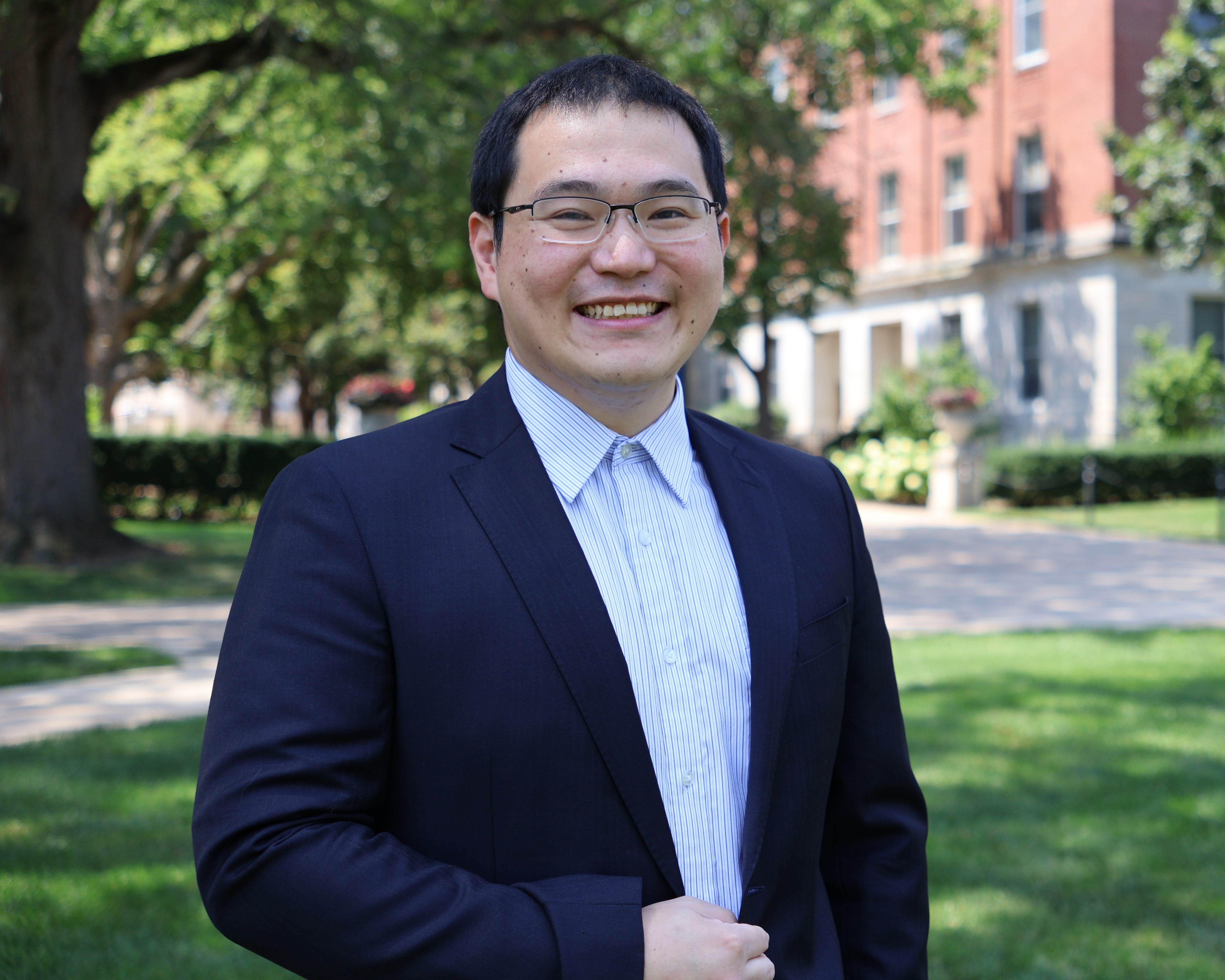
Assistant Professor Liwei Zheng comes to Illinois from Stanford University where he worked on next-generation protein sequencing as a postdoctoral fellow. Over several years at Stanford, he developed a process called “reverse translation,” which converts peptide sequence information into DNA output and enables massively parallel peptide sequencing with single-molecule sensitivity and single-amino-acid resolution.
At Illinois, Zheng will pursue research at the interface of bioanalytical chemistry, chemical biology, and organic chemistry. Specifically, he will explore unconventional use of DNA sequencing technologies and develop new chemistry that allows biological information not normally readable by DNA sequencing—such as protein sequences, molecular structures, and metabolite levels—to be converted into DNA signals.
“Since DNA sequencing is extraordinarily scalable and sensitive, these technologies, combined with well-established genomics and transcriptomics techniques, could help unify molecular quantification under a new sequencing-based paradigm,” Zheng said. “These technologies will advance single-cell proteomics, spatial molecular profiling, and new ways to study disease-associated molecular changes.”
A native of Hefei, China, Liwei was a high school student participating in the Chemistry Olympiad when he became fascinated by the intricacy of organic chemistry. He went on to do work on transition metal catalysis at Wuhan University and then pursued his Ph.D. at Johns Hopkins University, where he developed photochemical precursors to elucidate the mechanisms of oxidative DNA damage.
Since his undergraduate research at Wuhan University, his path through chemistry has taken him from organic synthesis to physical organic chemistry, chemical biology, and bioanalytical technology development.
“At each stage, I became increasingly drawn to the idea that chemistry can be used not only to make molecules, but also to ask and answer fundamental questions about biological systems,” he said. “Academia gives me the opportunity to pursue these questions, develop new technologies, and work with students and trainees as they grow into independent scientists.”
Pursuing his Ph.D. at Johns Hopkins in the lab of Professor Marc Greenberg, Zheng pivoted from organic synthetic methodology to chemical biology and physical organic chemistry and developed photochemical precursors to elucidate the mechanisms of oxidative DNA damage.
“This changed my perspective on organic chemistry and chemical biology. It showed me how carefully designed molecules can advance our understanding of organic reactions and even more complex biological processes,” Zheng said.
During his postdoc with Professor H. Tom Soh at Stanford, he was challenged with developing techniques for single-molecule protein sequencing, a very different type of problem from his Ph.D. work that turned into a journey of several years. In developing the “reverse translation” process, his Ph.D. training ultimately played a critical role in creating a DNA-compatible Edman degradation chemistry that serves as the cornerstone of the entire process.
“This reinforced for me how fundamental chemical training can unexpectedly enable solutions to new biological and technological problems,” Zheng said.
This fall, he will be teaching CHEM 520 – Advanced Analytical Chemistry in addition to building his research group and lab. He said he looks forward to working with trainees and creating a collaborative lab environment.
“As a mentor, I hope to create a group where students can develop strong chemical intuition, technical independence, and the confidence to pursue ambitious problems. I am also excited to work with colleagues to explore interdisciplinary topics,” Zheng said. “Entering this phase of my scientific career is especially exciting but also comes with uncertainty. Being independent brings the freedom to ask new questions and build a research culture from the ground up. I am looking forward to developing bold ideas with students, postdocs, and colleagues, and to seeing where those ideas lead.”