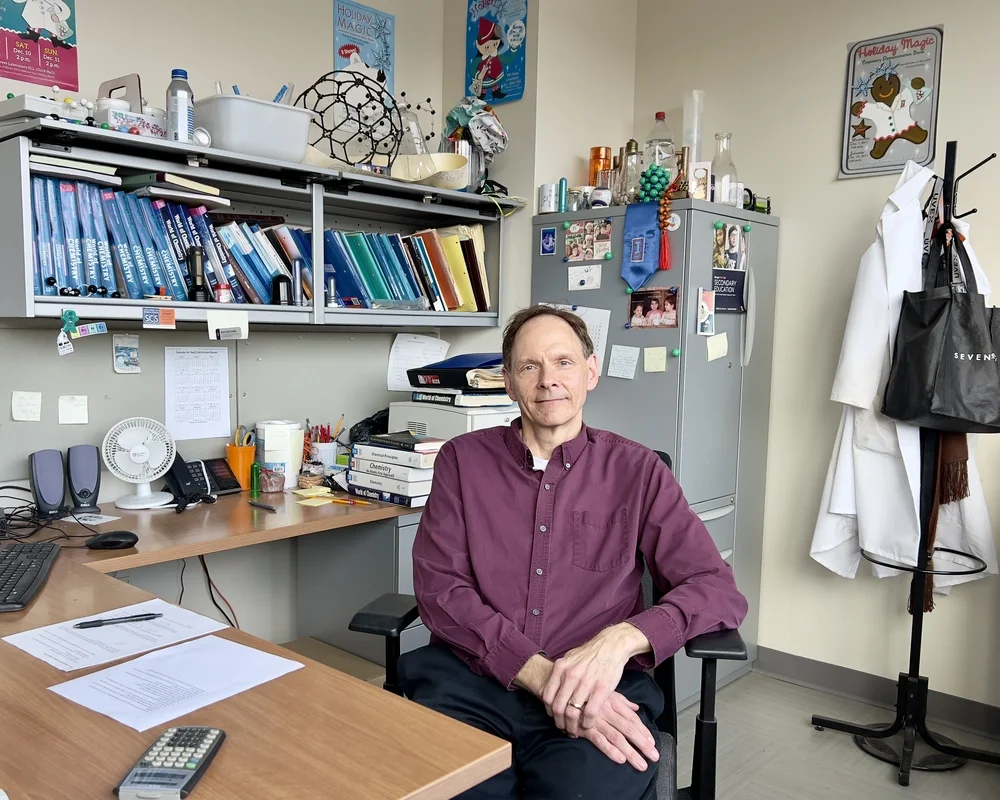
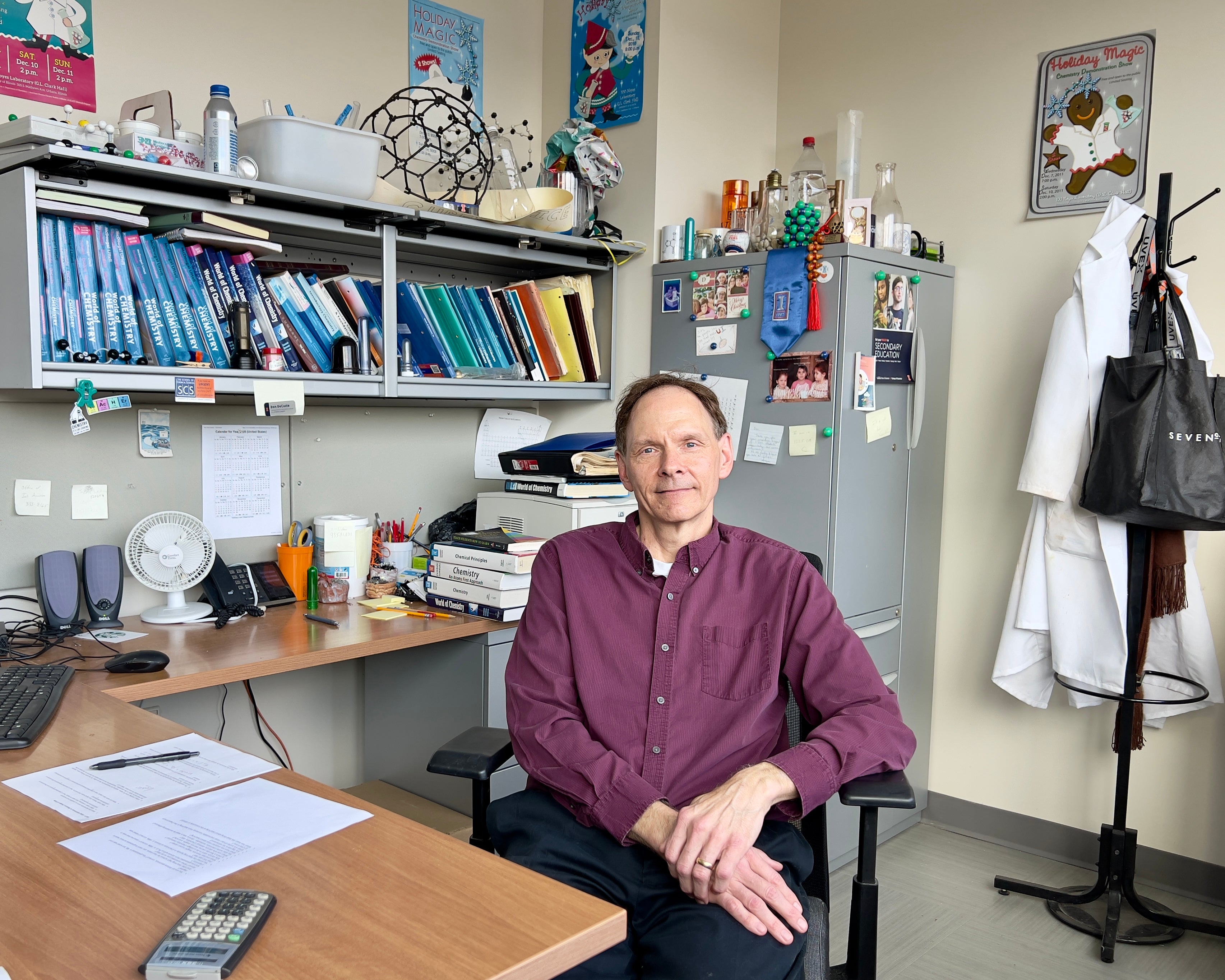
In his many years of teaching chemistry at Illinois, Don DeCoste has often shared his own story with students who are feeling uncertain about their major. As an Illinois senior in the Class of ‘88, DeCoste was on the pre-med track when he realized how much he enjoyed being a chemistry Teaching Assistant.
“I took all the courses you needed. I did the EMT training. I took the MCATs. I did the interviews. I got accepted to some medical schools. I did all this, and thought, ‘I just don't want to do this,’ ” DeCoste recalled.
In the middle of his senior year, DeCoste changed his career path.
“So, I try to tell the students it's never too late,” said DeCoste, who has no regrets, because that decision led to a very long and rewarding teaching career, the majority at Illinois.
“I've had such a great time. And maybe I would have had a great time as a doctor too, but I can't imagine it being better than this,” said DeCoste, who retired this summer as a Teaching Associate Professor of Chemistry after 30 years as a faculty member in the Department of Chemistry.
After that career path adjustment his senior year, DeCoste graduated in 1988 with a B.S. in chemistry. In 1989 he added a B.S. in curriculum and instruction from Illinois and headed west to California to teach high school chemistry and mathematics in Bakersfield.
After several years of teaching, including working with student teachers, he realized many of them were intimidated and unprepared to lead students in lab work. DeCoste decided to return to Illinois for his Ph.D. with a mission to help future chemistry teachers be more prepared to teach.
“So, I came to the College of Education at Illinois for that and did research in teaching and learning and also tried to figure out how can I best prepare people for teaching high school,” said DeCoste, who finished his Ph.D. in curriculum and instruction at Illinois in 1996. That same year, he joined the general chemistry teaching faculty at Illinois.
After a couple of years working with TAs in General Chemistry and in the chemistry demonstration room where he oversaw figuring out how to do demonstrations for instructors in classes, DeCoste began teaching his first course. CHEM 100 (now CHEM 101) was a class for students who were going to need CHEM 102 but didn't feel ready.
In some ways, DeCoste said, it was fantastic for him, because the course was like teaching at the high school level, because CHEM 101 students didn't have a lot of chemistry background and struggled with math at times. It also had a lab component, which gave him the opportunity to work with TAs.
“It was kind of everything that I wanted to do. I was teaching chemistry. I was helping people be teachers. I was getting to work with students in the lab. I did that for about six years, and it was just a great experience,” DeCoste said.
Eventually, he saw a need for a new course and developed CHEM 495, a class for undergraduate and graduate students interested in teaching high school chemistry. While the students who aspired to teach chemistry were taking chemistry courses and labs, they were not learning how to set up and organize lab classes and experiments.
“So even though we have some of the best and the brightest students on the planet coming here, they still would graduate here without ever really thinking about this,” DeCoste said. “And when they would go to the College of Education and get certified to teach, they would talk about methods of classroom management, which are important, but they didn't have a specific chemistry class.”
There are methods unique to chemistry, DeCoste explained, that teachers need to know how to manage, like dealing with chemicals, which can be dangerous, and disposing of them and making solutions, and more.
“There's just so much more to deal with, so I wanted to start the course to do that, and I can look back now and see teachers all over the country who have been through the course, so that's been very satisfying,” said DeCoste, who estimates that more than 200 students completed that class.
In three decades at Illinois, DeCoste taught 10 different courses, nearly every general chemistry course—101, 102, 103, 104, 105, 202, 203, 204, 205, and 495. He enjoyed doing chemistry demonstrations in class.
“Being able to do that in front of the students, to show them something, is just great. And especially, I always wanted to be safe, but they couldn't believe some of the things we would actually do. Some of the sounds that were made, how big the fireball was,” he said.
But CHEM 495 remains his favorite course to teach.
“Because I developed it. Because they were students interested in teaching. Because it was smaller and I got to know the students, and so it was different. I absolutely loved that course,” said DeCoste, who started teaching CHEM 495 in 2001. “I had a lot of teachers come through. A great number of them became teachers and have still been teachers and still contact me about what they're doing.”
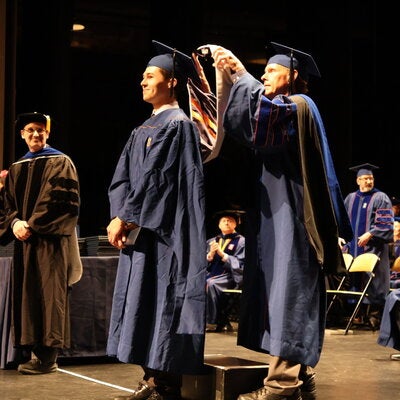
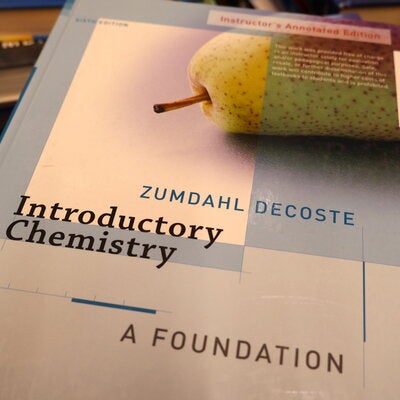
DeCoste also served as an academic advisor for students interested in teaching, including those in the Master of Science in Teaching Chemistry program. At the Department of Chemistry’s Convocation in May, DeCoste got to hood one of his last MSTC graduates, Ethan Ramirez. DeCoste also co-authored three chemistry textbooks with Steven S. Zumdahl, professor emeritus of chemistry, who had written a very successful chemistry textbook for college and was asked to write an edition for high school students.
Zumdahl brought DeCoste into the project, because of his high school teaching experience. DeCoste said he always enjoyed thinking about the material they teach and the various ways students learn and trying to figure out how to help students learn.
“I do care that they understand,” said DeCoste, whose teaching style was not about spoon feeding the information.
“Asking students questions about why does this work or how does this work, that challenges them a lot. They're not always comfortable with that. They don't always love me right from the beginning. But I think that acknowledging this is hard. This is different. This is why we're spending so much time on it, because we want you to grow. This is what we want you to do. And I don't expect you to be perfect at it now. I think being very explicit about that with the students, I think that definitely resonates with them,” he said.
He said it was great meeting a new group of students each year and watching them learn and grow.
“They come in and they're enthusiastic, and they like this stuff, right? So, it's just always great to be around that energy,” said DeCoste, adding that the first semester for freshmen is so tough.
“You were the best student in high school, and now everyone was the best student in high school. You have all these plans, and then you get that first test back, and you're like, oh. And for some reason, there's a pile of laundry growing in your room, and no one's doing anything about it. All that stuff is going on, and they’re just lonely and homesick,” he said. “But then I see them two or three years later and they're adults and they know what they want to do with life. And it's just so great to see that growth.”
DeCoste also enjoyed helping the students who came to him uncertain about what they wanted to do and then seeing them as seniors whose big decision now is what graduate school to attend.
“I'll tease them a bit and say, ‘do you remember the person who was in this office three years ago who almost dropped the class, who thought that maybe they couldn't do this, and now you have to choose between Stanford and MIT,” he said.
DeCoste also enjoys hearing from former students who have graduated.
“I tell them, one of the perks of this job is to hear about all your successes. So, if you have a chance, just send me a note. Tell me what you're doing,” he said.
The people are what DeCoste said has been special about teaching chemistry at Illinois.
“Obviously this place is just built for people wanting to focus on teaching and learning. And being able to do that has been wonderful,” he said.