Generally, water and electricity don’t mix well. But microdroplets of water – like 1/25,000th of an inch – have a surprisingly large degree of reactivity that makes them attractive for chemistry and electricity.
“They can accelerate reactions to like significant degrees. But essentially, one of the big things is those microdroplets have the ability to do electrochemistry,” said Gavin Hazen, a graduate student in the lab of Illinois chemistry Prof. Joaquín Rodríguez-López.
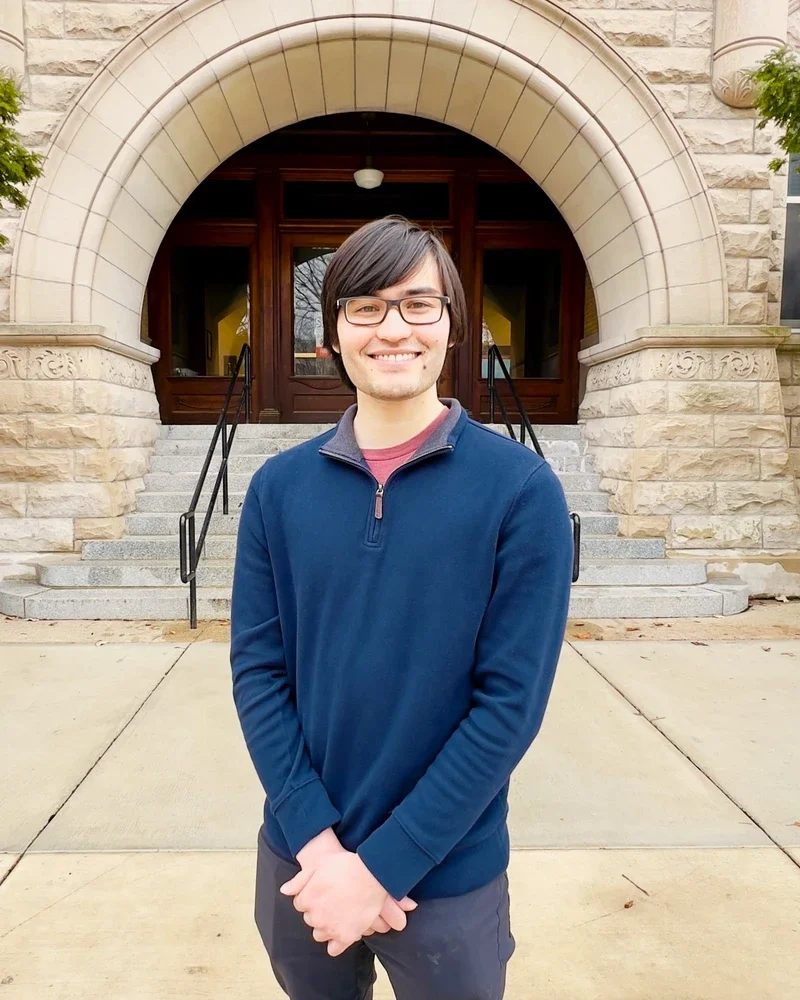
Hazen, a National Defense Science and Engineering Graduate Fellow, is investigating microdroplets as he works toward his Ph.D., and he’s hoping to discover that water and electricity can do some amazing things together.
“What our lab is really interested in is applying our electrochemical expertise to an entirely new field of micro-droplets. I want to bridge the gap of automated electrochemistry and micro-droplets,” said Hazen, who was selected for the NDSEG program and was also selected as a 2025 National Science Foundation Graduate Research Fellow.
“It felt amazing. I was very lucky,” Hazen said about being selected by both programs. He chose the NDSEG program, because it provided him with more opportunities to attend conferences and receive more professional mentorship. Despite all the hard work he put into his fellowship proposal, Hazen credits his mentors, especially Rodríguez-López and former lab member Michael Pence (Ph.D., ’25).
“I had great mentors. My mentors from undergrad have also been extraordinarily helpful. So, it's not just a me thing, but everyone around me and everyone behind the scenes as well,” he said.
As an undergraduate at Carleton College in Minnesota, Hazen was introduced to electrochemistry research in the lab of professor Steven Drew and worked on renewable production of hydrogen gas through photoelectrochemical water splitting.
“A lot of that research focused on using more common earth metals as opposed to the rare expensive metals to catalyze the splitting of water; so looking into using iron and copper and other common earth metals to do water splitting at a cheaper level, essentially. So that got me interested in electrochemistry, but also in sustainability and renewables and all of that, which I think is very important for the future,” Hazen said.
He applied to a lot of graduate schools but was attracted to Illinois and the Rodríguez-López group to learn automated electrochemistry.
“I fell in love with the idea of developing the systems to automate electrochemistry under Joaquin's guidance. The resources at this campus are also extraordinary, so that certainly helped with my decision,” Hazen said.
What does he enjoy most about his research? Tinkering and developing new instruments and platforms.
“And that's why the automation was so interesting to me. I got to build stuff and then apply chemistry with it, which I thought was awesome,” Hazen said.
In addition to undergraduate research, Hazen was in a robotics program throughout high school and took computer courses as a college undergraduate. Both skillsets have mixed well with what he is learning in the lab at Illinois.
“That has been a huge interest to me, applying all of the various skills I picked up from undergrad, my computer science knowledge, my robotics knowledge, and then combine it with my expertise in chemistry and really come up with something novel, essentially,” he said.
Hazen said Rodríguez-López has given him the freedom to “do his thing.”
“Joaquin's a great mentor. He guides you really well, but also, he's not afraid to sort of let you take the reins and explore the field yourself, which I think is really good for the development of a scientist,” Hazen said.
Growing up in Gilbert, Arizona, Hazen explored STEM at home and at school. His dad, who has a Ph.D. in chemistry, works at a startup developing an innovative glucose monitor with a team of engineers, physicists, and electricians. Their families would regularly get together and do fun STEM activities, which Hazen credits with cultivating his interest in science and chemistry. A regular event on the weekends, Hazen said, was astronomy night with telescopes in the backyard.
“We literally repeated the experiments to show that Pluto was a planet,” Hazen said. “My love for astronomy continued, but then it just translated into loving all my science classes, loving all my math classes, and then I got to college, and I just kept taking everything until eventually I was like, I really love chemistry. So, I continued with it, and here I am.”
Looking beyond graduate school, Hazen said he is very interested in continuing his research and bringing his expertise into industry.
“I'm thinking more towards the sustainability and renewable side of things. I'd really love to sort of bring automated chemistry to fields that want to explore catalyst development or explore renewable production of chemicals or fuels or whatever it may be, but I think it would be really great to bring my wide array of skills and apply it to different problems,” he said.
It’s not acquiring scientific skills and experiences that Hazen considers one of the most important lessons he has learned in graduate school. It’s overcoming challenges.
“It’s learning how to deal with things when they don't work how they're expected to,” Hazen said. “I would say it affects me all the time. I mean, it's made me stronger as a scientist, as a person, a little more tenacious.”
His tenacity drives him to continue learning and asking important questions. Hazen said an underrated secret to graduate school success is reading literature.
“I think it's very important to just read, read, and read,” Hazen said. “I think one of the biggest things is understanding that your science isn't in a vacuum. You are introducing your science into the context of a field, and it's very important to be able to understand that field. Literature allows you to get a good understanding of your field and ask the important questions. What does the field need to know? What can I help answer? And how can we go about that? So, reading literature. That has helped me succeed.”