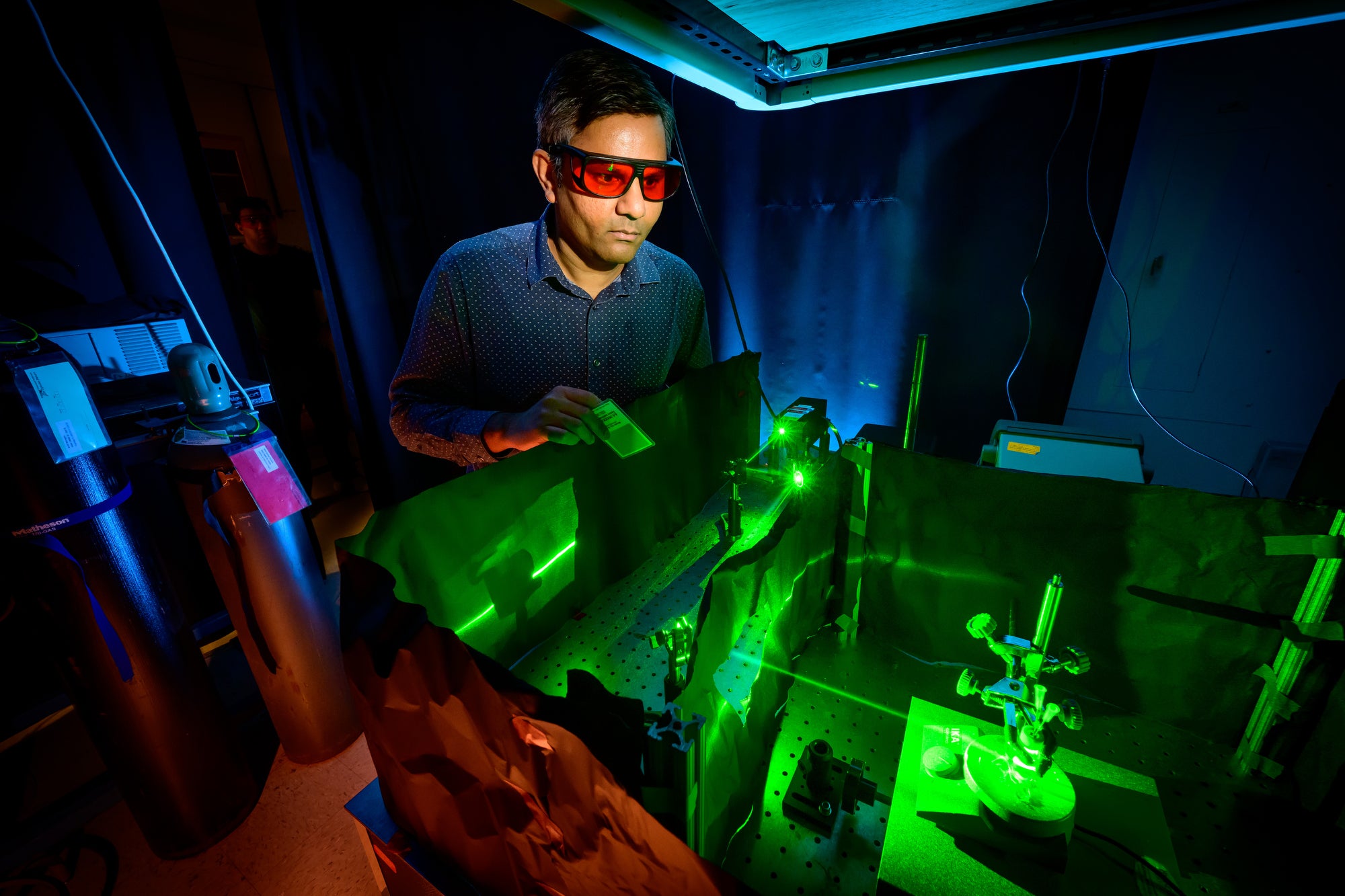
Several years ago, Prof. Prashant Jain and his research team were pursuing a sustainable way to synthesize ammonia when they made an unexpected discovery that light can be used to activate the splitting of ammonia to release hydrogen, a carbon-free fuel touted as a potential clean energy solution for a variety of energy sectors.
Ammonia is a promising alternative as a hydrogen carrier due to its high hydrogen content, easy liquidation, safer storage and transportation, and carbon-free combustion profile. But there is a challenge. The liberation of hydrogen or energy from ammonia requires its oxidation, a process that is sluggish and energy inefficient. The Jain lab had a possible solution involving light and electrochemistry, but at the time, the lab wasn’t known for electrochemistry.
“It would have been an uphill task to secure funding for research involving electrochemistry from one of the conventional funding sources,” explained Jain, G. L. Clark Professor of Physical Chemistry.
Around the same time, Prof. Martin D. Burke wanted to explore creating a “molecular prosthetic” for a missing enzyme that causes Ornithine transcarbamylase (OTC) deficiency, a fatal pediatric disease caused by a rare genetic condition causing high ammonia levels in the human body. The Burke group studies small molecules with protein-like functions that can be like molecular prosthetics to essentially do the job of proteins, an approach that has shown therapeutic potential for diseases such as cystic fibrosis and anemia.
Burke wanted to target a small molecule that catalyzes the reaction typically performed by the OTC enzyme to develop a first-of-its-kind therapy for OTC deficiency, but the project was considered very high risk.
“Nothing like it had ever been done before,” said Burke, May and Ving Lee Professor for Chemical Innovation. “As a result, no other group was willing to fund it.”
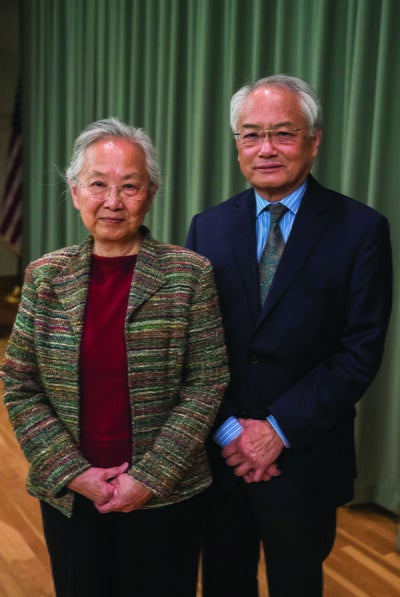
The Discovery Fund—established in 2018 through a gift from Illinois Chemistry alumni Ving Lee (Ph.D., ‘75) and May Lee (Ph.D., ‘76)—provided the initial boost of seed money for these high-risk, but potentially high-impact, projects.
In February 2014 during Prof. Greg Girolami’s term as Head, he incorporated the Discovery Fund as a major new component of the Department’s fund-raising strategy. The proposal stated that “the Discovery Fund is intended to enable Illinois Chemistry faculty, students, and alumni to lead the transformation of chemical sciences to meet the challenges of the 21st century.”
Girolami proposed the idea to prospective donors, including Ving Lee. The first Discovery Fund awards were distributed two years later, providing faculty members with $40,000 for one to two years to carry out exploratory research on an entirely new topic. The awards provide seed funding to enable researchers to secure longer-lived federal or private funding by enabling them to gather preliminary results that are the prerequisite for success in obtaining external funds.
Serving on various advisory groups, Ving Lee said it became abundantly clear to him that review processes and operational rules imposed by government agencies on grant recipients impede the development of nascent ideas.
“This has negatively impacted the traditional hard sciences – chemistry and physics," Ving Lee said. "As chemistry has evolved to be an interdisciplinary science, government funding has been thematically inconsistent, or unreliable. There is nothing more demoralizing than a comment on a grant review paraphrasing ‘lack of preliminary data to support…’ ”.
When Girolami approached them with the concept of the Discovery Fund, Ving Lee said they wanted to facilitate financial “seeding” of new ideas (to get that preliminary data) and encourage academic “out of the box – cutting edge” thinking.
“We are gratified by the impact these funds have on the evolution of various novel programs in chemistry and also in developing the newer generation of students,” Ving Lee said. “As Illinois has a rich history in chemistry of translating new ideas to commercial applications and business strategies, we chose to sustain this legacy through support of the next-generation technologies and researchers.”
Jain and Burke were recipients in the first round of the Discovery Fund in 2018, and both projects have produced good results. The support allowed Jain to further explore his lab’s unanticipated finding, which segued into a major development in the sustainable synthesis of ammonia.
“We developed a bifunctional catalyst that synergistically combines visible light absorption and electrochemical activity for splitting ammonia at a rate that surpasses other known electrochemical processes,” Jain explained. Their work was published in the journal Angewandte Chemie as a Hot Paper.
Not only is this new strategy promising for direct ammonia fuel cells, Jain said, but it may prove to be a general strategy for the use of concentrated solar power for boosting the electrosynthesis of chemicals.
In a 2022 JACS paper, the Jain lab shared more of their work. They demonstrated the synthesis of ammonium from nitrate powered by electricity and light with an electrocatalyst composed of gold nanoparticles that have dual attributes of electrochemical nitrate reduction activity and visible-light-harvesting ability due to their localized surface plasmon resonances. They showed that plasmonic excitation of the electrocatalyst induces ammonium synthesis with up to a 15× boost in activity relative to conventional electrocatalysis.
“Had it not been for the Discovery Fund support we would not have made the foray into sustainable ammonia synthesis using light and electricity,” Jain said. “Now, my lab is known for its development of excited-state electrocatalysis, and I have had funding supporting research in this area.”
The opportunity the Jain lab was given to investigate their unexpected finding also helped Enrique Contreras, postdoctoral researcher and first author of the 2022 JACS paper, to land a tenure-track faculty position at California State University in San Bernadino. And Jain lab researchers went on to make two additional advances on the synthesis of ammonia. One advance is the production of ammonia from very low concentrations of nitrate, and another advance—made possible by a collaboration with UIUC NPRE professor Mohan Sankaran—is directly from air with help from a plasma, Jain explained. Both of those developments are being written for publication.
Former Jain lab graduate research assistant Rachel Nixon (Ph.D., ’25) led the studies into those two latest advancements, which formed the topic of her dissertation. Nixon is now an NRC postdoctoral research associate at the U.S. Naval Research Laboratory in Washington, D.C.
Since the initial boost from the Discovery Fund, the Burke group has made substantial progress toward developing a small molecule capable of replacing the function of the missing OTC enzyme. OTC deficiency prevents the body from properly breaking down proteins and removing ammonia, the waste product produced during this process known as the urea cycle. OTC is an enzyme that helps the body break down proteins during this cycle.
“The primary driver of toxicity in OTC deficiency is unreacted ammonia,” Burke said. “Using a new class of molecular prosthetics, which we call prosthetic reagents, we have found a way to chemically react with and detoxify ammonia in human blood.”

The Burke group is currently working to apply this reaction in the leading mouse model of OTC deficiency, with the goal of countering hyperammonemia and restoring the urea cycle by replacing the OTC enzyme.
“Initial results we have collected in mice from some preliminary experiments are very encouraging,” Burke said. “In addition to targeting a top-notch publication, we are growing increasingly excited and hopeful about the potential real-world impact of this work, not only for OTC deficiency, but also as a potentially generalizable playbook for treating other diseases caused by the loss of enzyme function.”
Burke said the momentum they generated for this project with the Discovery Fund grant was critical to the renewal of their National Institutes of Health Maximizing Investigators’ Research Award (MIRA), which yielded $5.4 million in new funding. Now, the Burke group has expanded their efforts to explore the possibility of replacing the function of the entire urea cycle. Specifically, the group is developing second-generation prosthetic reagents designed to directly react with ammonia and form products that can be readily excreted from the body.
“This work represents an exciting extension of the original concept,” Burke said. “We have also recently started to pursue the development of prosthetic reagents for several other missing reactions that underlie other diseases.”
Diseases caused by a lack of enzyme function are inherently difficult to treat, Burke said, and existing treatments struggle to address the root cause.
“Prosthetic reactions offer the potential to make a significant impact by directly mitigating the accumulation of toxic metabolites or restoring missing metabolites on a rapid timescale,” he said.
Burke hopes this work will demonstrate the broader potential of new small-molecule therapies and ultimately help establish an entirely new field of medicine focused on molecular prosthetics.
“We understand this is very ambitious, but this was and remains our goal, and we are highly encouraged by the data we have generated thus far in the OTC project,” Burke said. “Support from the Discovery Fund was transformative for us and this project. We have now generated very promising results, including some recent early results in animals, and the preliminary data was critical for successfully renewing our NIH MIRA grant. We are tremendously grateful to May and Ving Lee for their visionary and powerfully enabling support.”
Other Discovery Fund projects
Since 2018, the Discovery Fund has supported more than a dozen starter projects in the Department of Chemistry.
Creating chemical probes as diagnostic tools and therapeutic agents

Through Discovery Fund support, Prof. Jefferson Chan’s research group obtained preliminary data to support a funding application to the National Institute of Biomedical Imaging and Bioengineering for an Exploratory/Developmental Grant designed to support innovative, high-risk/high-reward research in biomedical imaging and bioengineering. The Chan lab develops activity-based chemical probes for in vivo disease diagnosis and monitoring using photoacoustic imaging, using a “light in, sound out” method where laser pulses are applied to a tissue of interest while readout comes in the form of ultrasonic waves — just like in ultrasound imaging. The result is a safe, non-invasive diagnostic tool. The Discovery Fund support enabled the Chan lab to successfully design and optimize gas-filled microbubbles of various sizes, an advancement that is foundational to the lab’s ‘off-on’ design strategy of their chemical probes.
“Indeed, these results were important and necessary steps toward the development of analyte-responsive agents. In this regard, we also initiated the chemical synthesis of custom lipids with analyte-responsive units, which will ultimately be employed to construct activatable microbubbles,” Chan wrote in the Discovery Fund final report. “The next phase of research will focus on the optimization of these microbubbles for targeted therapeutic delivery and diagnostic imaging.”
Monitoring particulate matter using nanoelectrode collisions
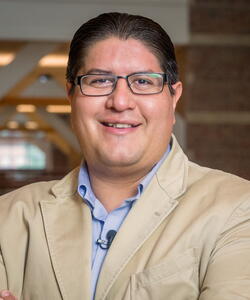
The Discovery Fund allowed Prof. Joaquín Rodríguez-López to pursue a new direction in his lab, the development of a new electroanalytical platform to monitor suspended particle matter (SPM) using collisional processes on microelectrodes. Monitoring SPM—microscopic solid particles such as PM10 and PM2.5 floating in the atmosphere—is crucial because they degrade air quality and are a suspected cause of pulmonary and cardiovascular disease in humans.
The Discovery Fund enabled researchers to set up experimental and microfabrication platforms, gain expertise with the measurements, and explore improvements suggested by computational simulation.
“We successfully started and demonstrated enhancements that will allow electrochemical particle matter sensors to be developed,” Rodríguez-López wrote in the final Discovery Fund report.
Former graduate student, Mike Pence (Ph.D., ’25), was fully trained in clean-room techniques and nanoelectrochemistry, wrote a manuscript on the work, and established a start-up. This knowledge allowed Pence to further develop advanced microelectrode platforms for applications in energy storage research. And the JRL lab secured funding from the Illinois Proof-of-Concept competition to continue their investigations to make the project grow.
“We were fortunate to be supported by the Discovery Fund at this critical time for research and we enormously appreciate Drs. May and Ving Lee for seeding this approach to address a growing environmental issue, and to bolster new ideas in electrochemistry,” Rodríguez-López said.
Potential diagnostic agents for devastating neurodegenerative disorders
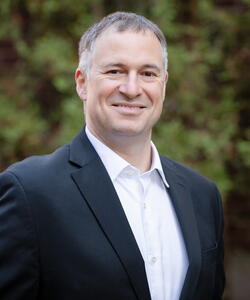
Liviu Mirica, William H. and Janet G. Lycan Professor of Chemistry, leveraged Discovery Fund support to develop novel magnetic resonance imaging (MRI) contrast agents that can cross the blood-brain barrier (BBB) for diagnostic applications in neurodegenerative diseases.
There is a need to develop diagnostic agents for the early detection of the formation of oligomeric aggregates of amyloid proteins involved in neurodegenerative disorders. The Mirica group has developed BBB-permeable Positron Emission Tomography imaging agents for the in vivo detection in mice of Aβ plaque—clusters of misfolded amyloid-beta proteins that accumulate between nerve cells in the brain.
With Discovery Fund support, the Mirica group developed a series of chelators that were hypothesized to enhance the performance of manganese(II) oxide complexes as MRI contrast agents. Two promising compounds were identified as optimal candidates for detailed in vivo MRI studies, resulting in a successful National Institutes of Health grant application, the filing of a provisional patent application, and a published paper.
DNAzymes for Covalent Modification of Small-Molecule Compounds

Researchers in Prof. Scott Silverman’s lab work with DNAzymes, which are artificial single-stranded catalytic DNA sequences, much like natural protein enzymes are catalytic amino acid sequences.
The Discovery Fund award was key to enabling the Silverman lab to expand efforts in a new direction, using DNAzymes to catalyze reactions of small-molecule substrates.
“In the past, we have primarily used DNAzymes to catalyze reactions of substrates that are other biomolecules, namely DNA, RNA, peptides, and proteins,” Silverman wrote in the Discovery Fund final report. “The practical challenges with small-molecule substrates are substantial, and traditional funding sources are skeptical until we can generate suitable preliminary results.”
The Discovery Fund award enabled former graduate student, Prakriti Das (Ph.D., ’25) to devote substantial effort to generating preliminary results.
“In turn, we hope to have significant impact using DNAzymes, which in principle can catalyze a broad range of reactions with small-molecule substrates,” Silverman wrote. “One of our longer-term goals is to identify DNAzymes that acylate amines of small molecules.”
With their preliminary results and published work, Silverman can seek new funding from the National Institutes of Health and the National Science Foundation to achieve the lab’s longer-term goal of DNAzymes for small-molecule amine acylation.
“Only rarely do faculty have the financial means to allow their lab members to work in a new research direction, without having to satisfy the specific constraints and expectations of a funder,” Silverman wrote.
A New Class of Triggerable Catalysts

In industry, many customers carry out catalytic reactions such as polymerizations but are not chemically adept, said Gregory Girolami, William H. and Janet G. Lycan Professor of Chemistry. For those customers, he said, it would be an advantage if they could avoid the need to carry out chemical procedures such as mixing the catalyst with the polymer starting materials.
The goal of the Girolami group’s Discovery Fund project was to develop an entirely new kind of “triggerable” catalyst system. In other words, the catalyst could be premixed with the starting materials, but the catalyst remains latent for an extended time until the customer applied a trigger.
“We successfully developed several such polymerization catalysts that remain insoluble in the mixture of starting materials (and thus inactive) until the mixture is heated. At a specific temperature, the catalyst dissolves suddenly and the polymerization reaction commences,” Girolami said.
The project resulted in the successful development of new catalytic systems that have long shelf lives in their latent form but catalyze the desired reaction rapidly once the external thermal trigger is applied.
Recently awarded Discovery Fund projects
- Scott Denmark, Reynold C. Fuson Professor of Chemistry, is creating a workflow for the systematic discovery of new organic reactions and reaction mechanisms.
- Prashant Jain, G. L. Clark Professor of Physical Chemistry, and Angad Mehta, assistant professor and T. M. Balthazor Faculty Scholar, are developing a new technology that combines yeast biosynthesis and solar-driven carbon dioxide reduction for sustainable manufacturing directly from carbon dioxide.
- Jonathan Sweedler, James R. Eiszner Family Endowed Chair in Chemistry, is creating a single-cell mass spectrometry workflow to explore enteroendocrine cell heterogeneity and determine how peptide hormone processing in the gut changes during the development of metabolic disorders.
- Prof. M. Christina White, William H. and Janet G. Lycan Professor of Chemistry, is pursuing the Artificial Intelligence-driven discovery of late-stage methyl C—H oxidation reactions.