A rising junior in biochemistry on the pre-med track at Illinois, Jairo Ortiz remembers hearing students talking about organic chemistry before he ever took an organic course.
“I heard students talk about how hard organic chemistry is, emphasizing how complicated it gets and how it is almost like learning another language,” Ortiz said.
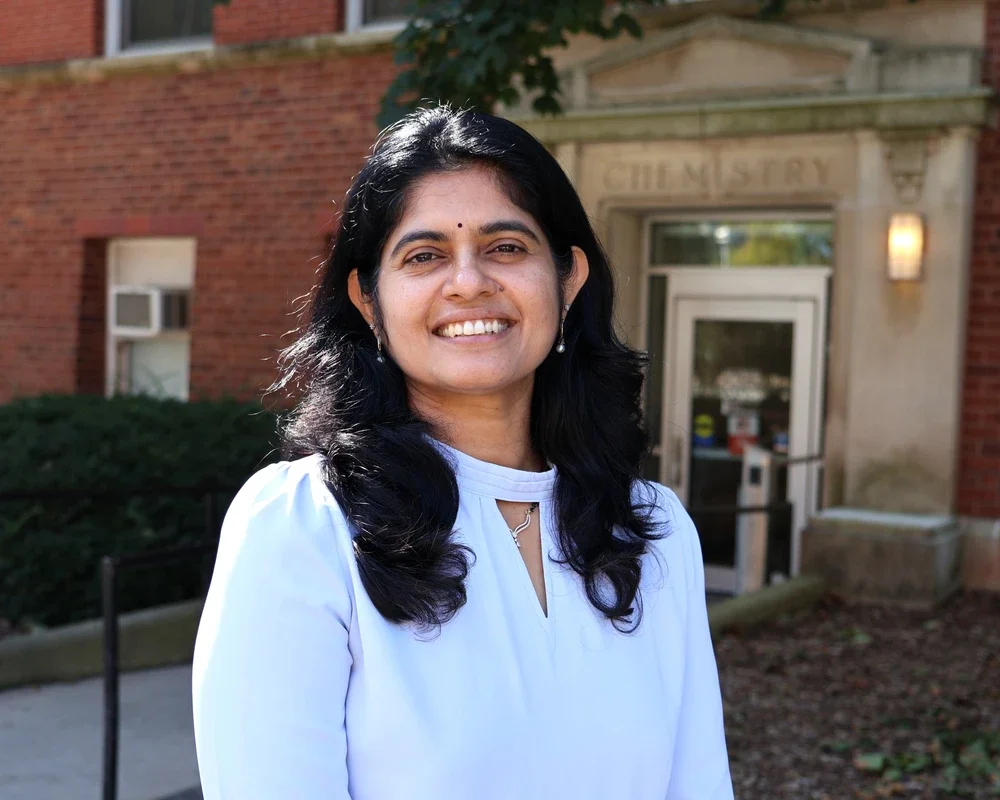
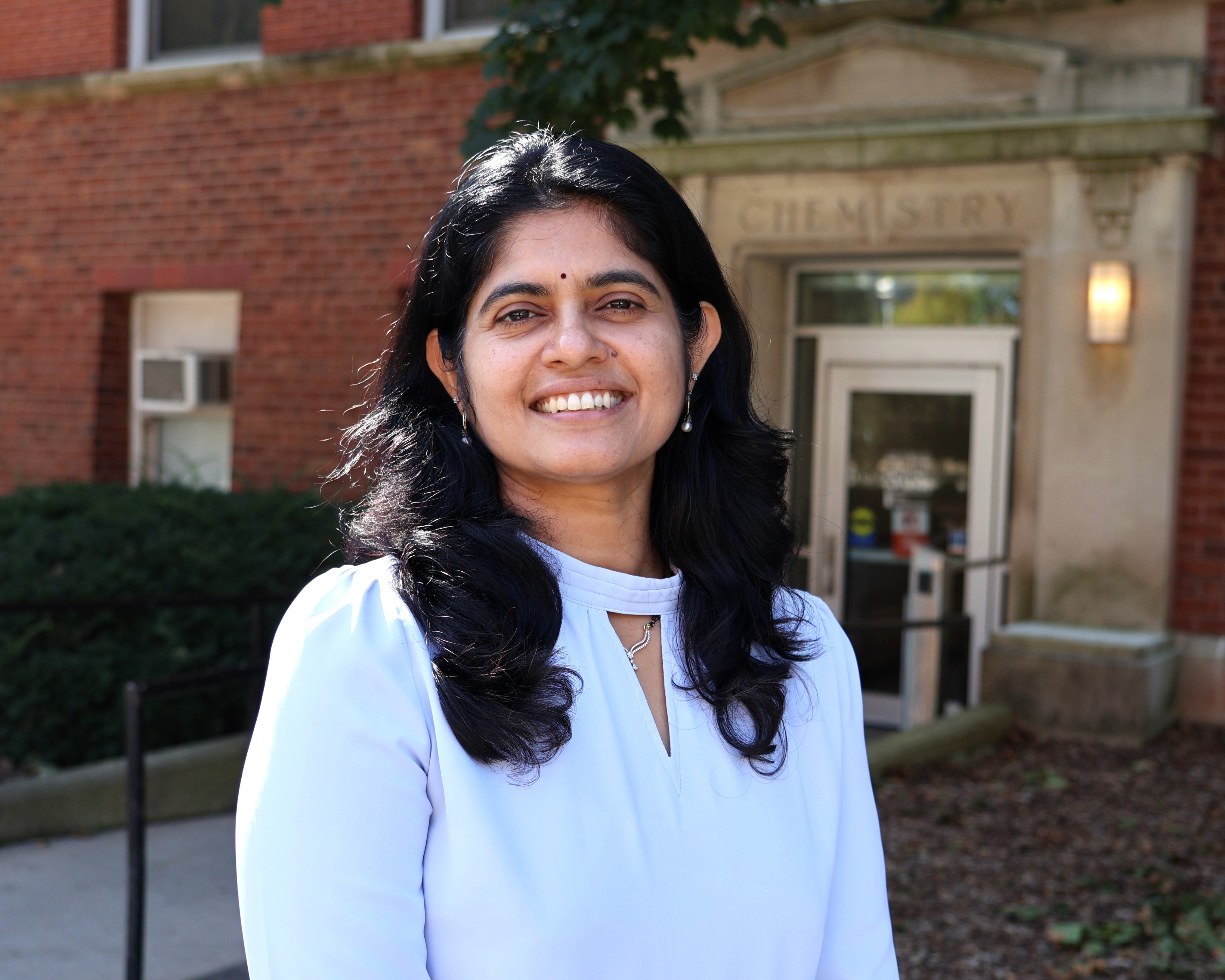
That’s no surprise to Smitha Pillai, senior lecturer in Chemistry at Illinois. After 12 years of teaching college chemistry, Pillai knows the notorious reputation of organic chemistry as difficult and a “weed out” course.
“It's not a good title, right?” Pillai said.
Organic chemistry is challenging for a variety of reasons — a wave of new vocabulary, hundreds of chemical reactions, and cumulative concepts to name a few. Students can’t rely solely on rote memorization and must understand the why and how of reaction mechanisms, learn to visualize molecules in 3D space, and master each concept as they build on one another.
When Pillai came to Illinois after nearly a decade of teaching at Arizona State University, she saw the transition as an opportunity to explore a new way of approaching her large lecture organic chemistry courses. She had come to believe the traditional way of presenting the material was not instilling a deep understanding of foundational organic chemistry concepts and the importance and relevance of those concepts in our everyday lives.
“When you like your subject so much and you're so passionate about it, you don't want your students to be scared and not like it, right? You want them to enjoy it the way you do. So that has always been a challenge,” she said.
After talking with Illinois Chemistry professor Jeffrey Moore, Pillai was more inspired to tackle that challenge. Moore, Stanley O. Ikenberry Research Professor, and Research Professor of Chemistry, tried a new approach to teaching CHEM 332 – Elementary Organic Chemistry II in the Spring of 2024. Rather than deliver a traditional survey of reactions, synthesis, and mechanisms, he taught a process that he called “making sense of molecules.”
“Rather than asking students to memorize large amounts of information, we asked them to repeatedly confront challenging molecular problems and develop explanations for what they were observing. The emphasis shifted from remembering chemistry to making sense of chemistry,” Moore said. “Making sense is an active process. Students generated hypotheses, explanations, diagrams, mechanisms, models, and interpretations. They were constantly producing. In many ways, the production was not simply evidence of learning—it was the learning.”
The approach better reflects how science is practiced, Moore said.
“Scientists spend far less time recalling facts than they do trying to make sense of observations,” he said. “The ability to build explanations, test ideas, revise them, and communicate them is far more durable than memorizing information for an exam. It also fits naturally with emerging AI tools, which can generate possibilities but cannot decide what ultimately makes sense.”
Talking to Moore was encouraging to Pillai, who was preparing to teach CHEM 332 in Fall 2024. Moore’s classroom experiment helped her envision how to restructure the course into a hybrid of an active learning style like Moore’s approach and the traditional way she had been teaching organic chemistry.
“I was very lucky to talk with him and hear about his experience because he felt it very rewarding. And I felt it was what I was thinking about but didn't know how to put in a structured way in a course this big. If you have 50 students, it's okay. But if you have 300 or 400, it’s more difficult,” Pillai said.
A large enrollment course of 300-400 students, CHEM 332 is required for Illinois chemistry majors as well as students in agricultural, nutritional and biological sciences, and students on premedical, predental, and pre-veterinary tracks.
Pillai wanted to incorporate a molecule-based active learning element into the course yet still retain the core of the foundational organic chemistry topics and concepts that are critical for students preparing for a career in chemistry or competitive exams for entrance to medical, dental and veterinary schools.
Pillai spent the summer of 2024 developing the new class material and a syllabus for CHEM 332, adding a molecule-based final project to the course.
Students choose a compound from a list of compounds used in everyday life and must complete a series of exercises with that compound. They can work individually, or in groups. Compounds range from those used for medicinal drugs to polymers that are made into everyday products. Some students pick dyes, she said, like the Red 40 dye in M&Ms.
“They're very curious about all those things,” said Pillai. When they choose their compound, she said they’re more engaged and interested and want to know everything about it.
First, a literature search is required to learn about the compound, then a structural analysis, then they must draw their compound’s structure, label the functional groups, find a published research paper about their compound and write about how the compound is synthesized and then focus on the functional group reactivity of their compound.
“They have to look back to their notes from the semester and relate what they have learned in the lecture to the project and write about it,” Pillai said.
She also asks them to address additional prompts, including the pharmacological role and biological role of their compound, its environmental impact, and then its real-world application.
“Once the material is all presented in lectures, this gives them a chance to step back and see what they learned and how they can apply it. So that is very rewarding for them,” Pillai said.
Ortiz said Dr. Pillai's class changed his perception of organic chemistry for the better.
“Her explanations to problems and concepts, as well as connecting that to real life, definitely helped me remember the ideas better and not simply memorizing the reactants of a specific reaction,” said Ortiz, who chose the compound linalool, used as a fragrance and as a potential antidepressant.
Ortiz said the project helped him take apart large compounds and predict reactions.
“Before this project, looking at huge chemicals felt daunting because there was just so much going on. The project forced me to slow down and think it through, breaking down the chemicals into their functional groups, giving me a better understanding of what type of reactions the chemical could be used in, or even be a product of,” Ortiz said. “I realized that chemicals I had never heard of are actually part of everyday life, something we might inhale or consume without even realizing it.”
Another pre-med student and recent graduate, Maya Kafali (B.S., ’26) said she was a little scared to take CHEM 332 in Fall 2024, but she learned to love the class and the final project, which she said moved learning beyond just memorization.
“This project helped me apply what I learned beyond exams and see how these compounds are actually used in real-world and pharmaceutical settings,” said Kafali, who chose the compound Citral, which is found in perfumes, soaps, and other fragrant products due to its lemony aroma.
Kafali said the project helped her learn how specific functional groups in a compound can contribute to that compound's physical and chemical properties.
“Citral's aldehyde group exhibits a specific polarity and molecular vibration that is responsible for the compound's lemony scent,” she said.
Last year, researchers at the Georgia Institute of Technology reported their findings from a 10-year study analyzing the impact of active learning in introductory organic chemistry courses. The researchers found that “the implementation of evidence-based active learning strategies significantly enhanced students’ success in the course by about 0.46 course GPA points” and it also reduced the rate of students withdrawing from the course.
After two years of her new teaching approach, Pillai said students have demonstrated not only strong engagement with course material but also meaningful connections between organic chemistry and real-world applications.
In their written reflections, Pillai said students have emphasized how the experience moved learning beyond memorization, connected their learning to biological and medical contexts, and revealed how directly chemistry connects to everyday life.
“Together, these reflections illustrate how the project helped students develop deeper conceptual understanding, while also making chemistry more relevant, tangible, and impactful across different levels of learners,” Pillai said.
She has continued to tweak this new approach to teaching CHEM 332, and this spring, she received an Innovation Mini Grant from the Provost’s Office for her proposal, “Connecting Organic Chemistry to Real World Contexts Through Molecule Centered Learning.”
The grant funds are helping her to refine and implement her molecule-centered learning project in the Organic Chemistry II courses by improving project prompts and assessment rubrics, analyzing multi-semester survey and reflection data, and developing reusable instructional materials, including a structured Canvas-based module for student guidance, reflection, and assessment. Pillai said the funds are also being used to support a graduate or undergraduate assistant to help with data organization, analysis, and materials development.
In July, Pillai presented her work on this project at the Biennial Conference of Chemical Education. She said she is excited to share this with other educators in the chemical sciences and receive feedback from other instructors, especially because this deviates from the traditional way of teaching organic chemistry.
Moore said what impresses him is that Pillai was willing to rethink assumptions about teaching and assessment and do the hard work of implementation.
“It is easy to continue doing what we have always done. It is much harder to make changes when you believe students can learn in a better way. Smitha deserves a great deal of credit for taking on that challenge,” Moore said.