URBANA – Researchers at the University of Illinois Urbana-Champaign have developed a fast and simple way to turn lignin, a plentiful plant-based byproduct of the paper making industry, into potentially more valuable renewable chemicals.
More than 50 million tons of Kraft lignin are generated annually as a byproduct of the global pulp and paper manufacturing process. Lignin, a complex organic polymer that gives plants and trees their structural rigidity, becomes Kraft lignin when it’s separated from the black liquid waste leftover from the paper making process. More than 90% of Kraft lignin is incinerated on-site at paper mills to recover pulping chemicals and generate energy.
In recent years, significant efforts have been focused on using renewable raw, natural materials, like lignin, to replace chemicals typically made from petroleum.
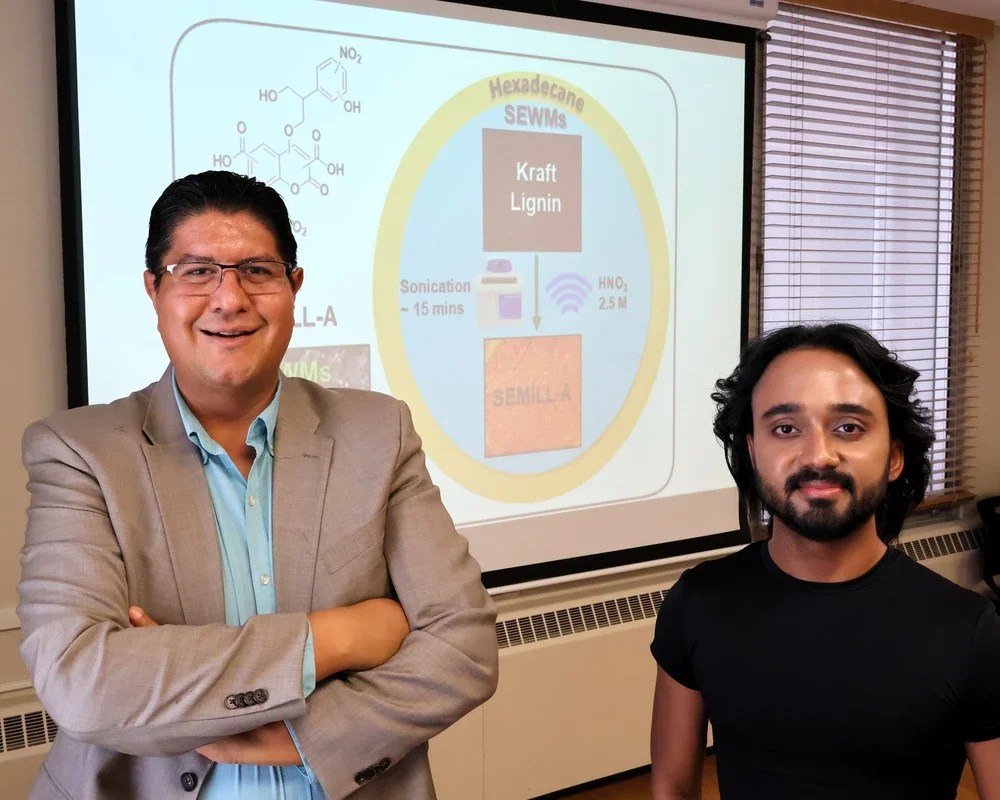
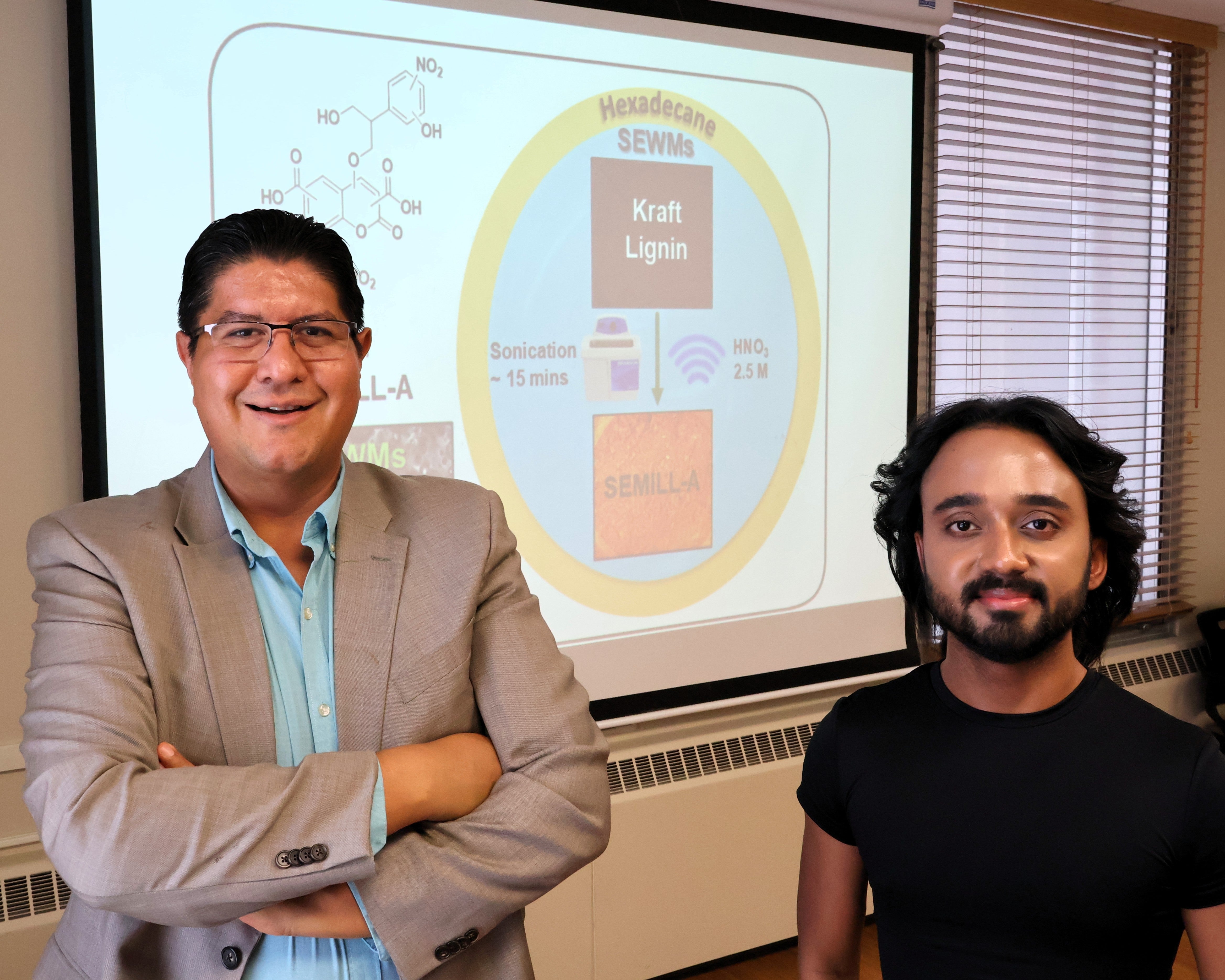
Finding new ways to transform and use biomass such as lignin was the overarching goal of the Illinois research team led by Joaquín Rodríguez-López, professor of chemistry at Illinois, and graduate student Supriya (Riyo) Das. Recent studies have shown great potential for Kraft lignin to be utilized in more valuable ways, but harnessing its full potential has proved challenging through thermochemical and electrochemical methods that require catalysts and often harsh reaction conditions that result in low conversion rates.
The new method developed by Rodríguez-López and Das uses tiny water droplets energized by sound waves to break down Kraft lignin in just 20 minutes at room temperature and without added catalysts or harsh chemical conditions. Rodríguez-López said the dark-colored powder form of Kraft lignin is ultimately transformed into a redox active molecule that has a beautiful orange color in powder form.
“Yes, like Illinois orange,” said Rodríguez-López, who explained that the drastic change in color is another indication of a reaction and transformation.
In their study published in the journal Small, the team details how their microdroplet method converted about half of this complex biopolymer into a smaller molecule that has potentially valuable attributes for energy and chemical applications.
Das said their process has a good conversion rate with about 56 percent of the lignin converted.
“So that was very interesting, very new,” said Das, adding that previous studies using other methods to depolymerize lignin have not reported such a high yield of a selected product.
Das said it has been exciting to discover this unique molecule and name it. The Sonicated Emulsive Microdroplet, SEM, compound was discovered at Illinois, ILL, so they named it SEMILL-A.
“I think that we've tapped into a unique process to deconstruct complex biomass. It was very unexpected. And that's what makes it so very rewarding,” said Rodríguez-López, whose study is part of the DROPLETS project at the Beckman Institute for Advanced Science and Technology at Illinois. DROPLETS is funded by the U.S. Department of Energy’s Office of Science through its Science Foundations for Energy Earthshots initiative.
Microdroplet chemistry studies are surging as scientists have discovered that these tiny drops of water—much smaller than raindrops—can drastically accelerate chemical reactions compared to bulk solutions. They can also spontaneously generate reactive oxygen species like hydrogen peroxide without external catalysts.
The microdroplet method devised by Rodríguez-López and Das uses ultrasonication, a technique that uses high-frequency sound waves to agitate particles in liquid and generate microdroplets of water that break down the lignin, a highly complex polymer with difficult-to-break bonds. They call the droplets sonicated emulsive water microdroplets (SEWMs) and the simple room-temperature process happens in a small container using just oil, water, lignin and some acid. No high temperatures and no expensive rare earth metal catalysts required.
“The chemistry is complex, but fascinating,” Rodríguez-López said. “The Kraft lignin is broken down into a small molecule and the small molecule forms new functional groups that make it redox-active and pH sensitive.”
Rodríguez-López and Das collaborated with fellow Illinois chemistry researchers Jeffrey Moore and Jonathan Sweedler and Charles Schroeder, professor of chemical and biological engineering at Princeton University, for their expertise and specialized equipment to further characterize this new molecule and confirm their unanticipated results. The team used optical microscopy, infrared spectroscopy, 1D and 2D nuclear magnetic resonance spectroscopy, high-resolution mass spectrometry, chromatographic, and electrochemical analysis to confirm their findings. Collaborators from Argonne National Laboratory also helped with key simulations of molecular motifs in SEMILL-A.
“And it turns out that yes, we were obtaining something that we think is really special,” Rodríguez-López said. “We show the possibility of SEWMs to cleave bonds and to facilitate the nitration in Kraft lignin and a model compound.”
This new molecule can accept and donate electrons, a crucial feature for energy storage in batteries, which is a major research thrust of the Rodríguez-López electrochemistry lab.
“So that makes SEMILL-A interesting for energy storage. Does it mean that this particular molecule is going to be finding its way to a battery? Maybe, maybe not,” Rodríguez-López said. “But the question now is how can we modify the conditions of this reaction or better understand what is happening so we can produce the type of molecule that we want and transform it into something that I can put in a battery, for instance a redox flow battery?”
The researchers also emphasized that the microdroplet reaction process itself holds great potential for future studies.
“So now we're trying to understand the different aspects of this deconstruction process and how the molecule becomes nitrated. There's an incorporation of new functional groups and now we're trying to isolate effects, while also exploring whether we can do this on other biopolymers and plastics,” Rodríguez-López said.
Editor’s notes:
The published paper, “One-Step, High-Yield Deconstruction of Kraft Lignin into a Redox-Active Small Molecule Using Sonicated Emulsive Water Microdroplets”, can be accessed at DOI: http://doi.org/10.1002/smll.74934.
Contact: For more information, contact Joaquín Rodríguez-López, professor of chemistry, University of Illinois Urbana-Champaign at joaquinr@illinois.edu.