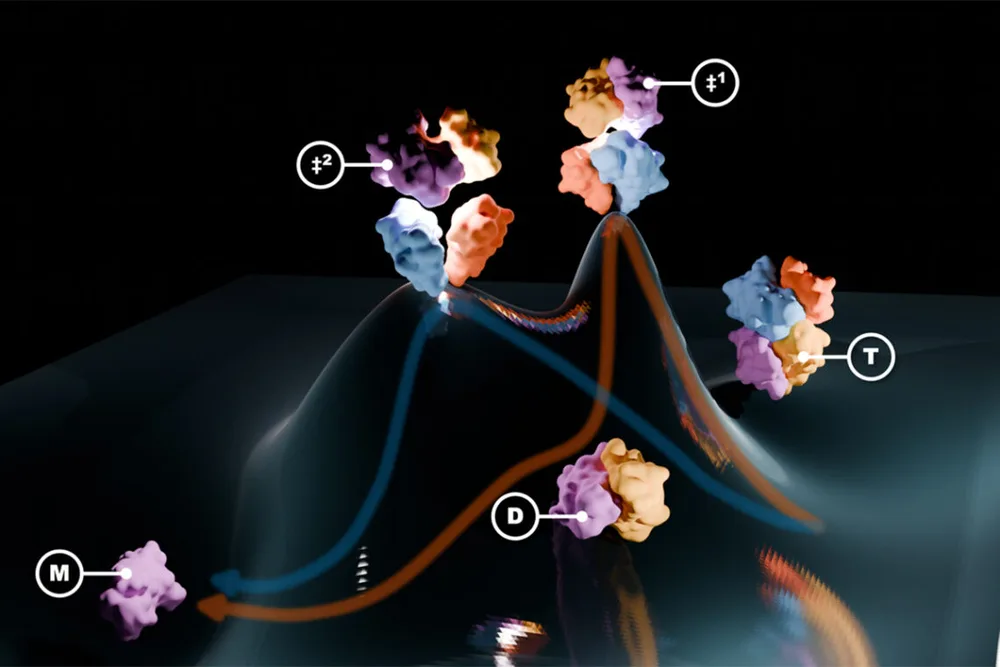
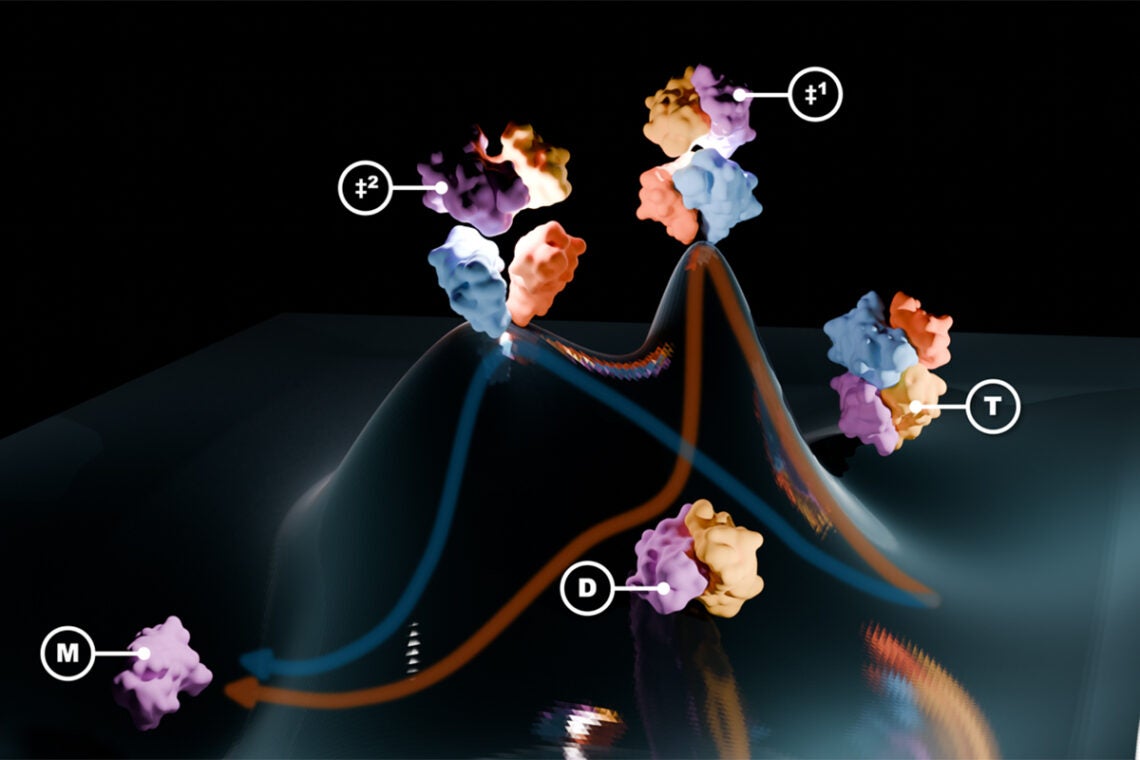
The protein transthyretin can unfold and dissociate in a previously unknown way, possibly contributing to a rare and deadly form of amyloidosis, new findings from Scripps Research and the University of Illinois Urbana-Champaign reveal.
The study, published in the Proceedings of the National Academy of Sciences, may offer new avenues of research for a condition that affects tens of thousands of people in the United States.
TTR is a protein that helps transport vitamin A and the thyroid hormone thyroxine in the blood, cerebrospinal fluid and the eye. Over time, its four-unit structure splits into pieces that can misfold and clump together, causing one of the most common forms of systemic amyloidosis in humans, particularly in the heart and nervous systems.
One of the standard treatments, a drug called tafamidis, works by helping TTR stay intact and slowing how it normally unfolds. However, the Scripps and Illinois researchers have discovered a second, previously unknown TTR unfolding pathway that may cause protein aggregation in some rare hereditary forms of the disease.

“Any new pathway by which a protein could unfold, and thus subsequently form amyloids, is of interest because it may not react to drugs in the same way as the previously known pathway,” said Martin Gruebele, a U. of I. professor emeritus of chemistry and co-corresponding author of the paper. “This finding also furthers our understanding of protein folding and unfolding. Parallel pathways have been proposed by energy landscape theory since the 1990s, yet very few cases have been clearly identified.”
“TTR is, as far as we know, the first time multiple pathways have been shown in a multimeric protein where dissociation and unfolding go hand-in-hand,” said Scripps researcher Marcus Jäger, the first author of the paper.
To uncover the alternative pathway, the researchers tested more than 100 TTR variants, measuring how quickly each unfolded across a range of conditions. They supported their findings using cryogenic-electron microscopy and previously published X-ray crystal structures.
The results reveal that some variants of TTR have a second unfolding route in which the four-unit structure falls apart more directly, without the two-unit intermediates formed in the traditional pathway. The TTR variants that can unfold by the alternate pathway include some that cause amyloidosis in the brain.
“We need to understand whether this alternative pathway can lead to TTR aggregation in the cerebrospinal fluid, which could potentially translate into worse outcomes for patients carrying these rare mutations who take the current medications,” said study leader Jeffery Kelly, the H. Lutcher Brown Professor of Chemistry at Scripps Research, who also co-developed tafamidis.
The alternative pathway also is favored under acidic conditions — the environment found inside lysosomes, the cellular organelles where proteins are broken down and recycled at the end of their life cycle.
“This route probably evolved so TTR can be degraded, which is important, but can also have side effects,” Gruebele said. “If TTR could dissociate and unfold via a new pathway in that environment, this could open it up to aggregation and amyloid formation.”
For people with the most common types of TTR amyloidosis, the alternative pathway appears too slow under normal conditions to compete with the known pathway. But certain disease-associated mutations appear to make the new pathway more accessible, even at normal blood acidity, Kelly said.
“More research is needed, but this study opens up a new direction in the field of drugs targeting specific amyloidosis pathways,” said Gruebele. “At least we have one of several possible smoking guns to look at.”
More broadly, the findings could inform how scientists think about other proteins linked to degenerative disease, according to Kelly.
“This is an amazing example of using traditional biophysics to conclusively demonstrate that parallel pathways can govern the folding and unfolding of a protein, which historically has been hard to demonstrate experimentally,” Kelly said.
This work was supported by the National Institutes of Health grant R01 DK046335 and a postdoctoral fellowship from the German Research Foundation.
Editor's note:
This content was adapted from a release by Scripps Research.
To reach Martin Gruebele, email mgruebel@illinois.edu.
To reach Jeff Kelly, email jwk@scripps.edu.
The paper “Transthyretin can denature by an alternative pathway” is available online. DOI: 10.1073/pnas.2536532123