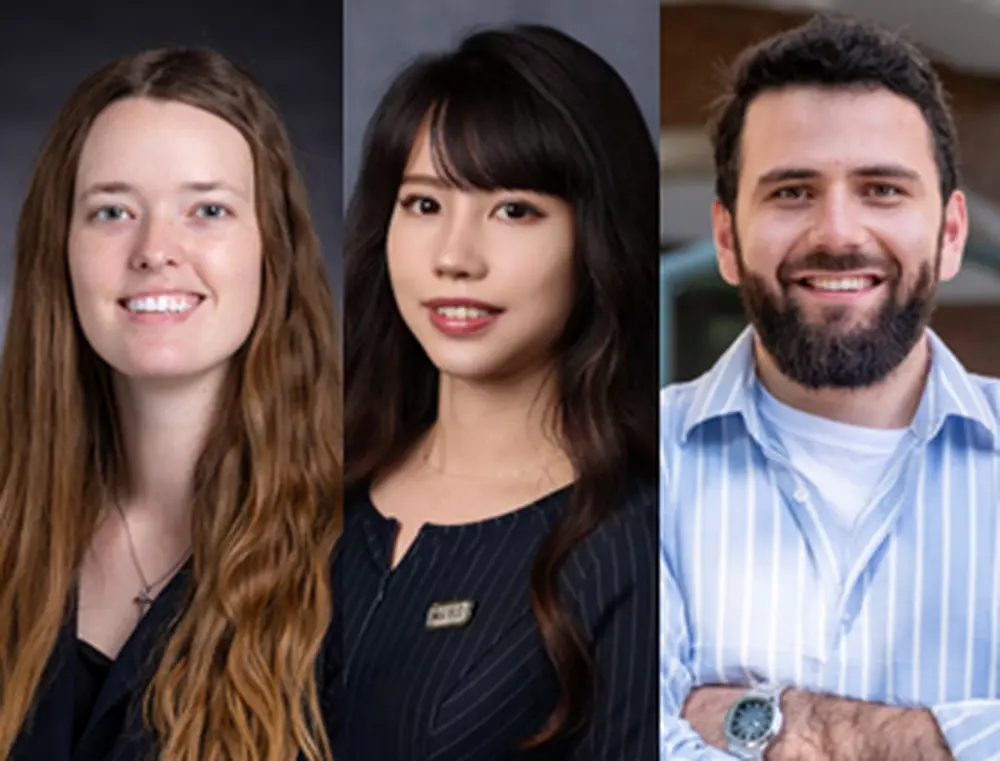
The Beckman Institute has recognized a new cohort of Beckman Institute Graduate Fellowship recipients. These students are working on projects related to material science, chemistry, brain functions, cancer and other diseases. Read on to learn more about the three fellowship recipients in chemistry and their research.
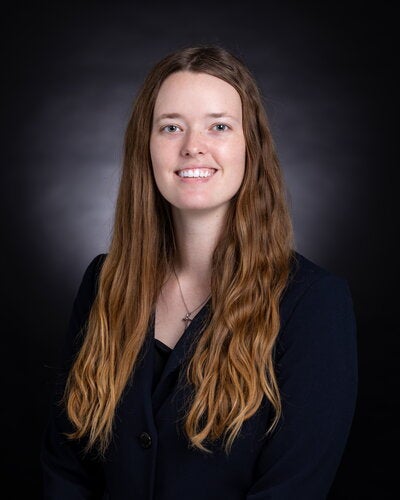
Faith Kern
Faith Kern is a third-year chemistry Ph.D. student at Illinois. She earned her B.S. in chemistry, with minors in Spanish and communication studies, from the University of Florida in 2024.
When materials like metal or plastic are placed under stress, such as bending or twisting, the physical appearance of the object changes, and the molecular bonds at the core of the material are shifted in the process.
Using a force-responsive molecule known as a mechanophore, Kern and other researchers can more accurately learn how these complex networks of chemical bonds respond to physical force loads. By conducting these observations, researchers can more accurately understand how plastic materials deform.
Kern is collaborating with adviser Jeffrey Moore, a professor emeritus of chemistry and a Stanley O. Ikenberry Endowed Chair Emeritus of chemistry; adviser Nancy Sottos, a Maybelle Leland Swanlund Endowed Chair of material sciences and engineering; Randy Ewoldt, an Alexander Rankin Professor of mechanical science and engineering; and Sameh Tawfick, a professor of mechanical science and engineering.
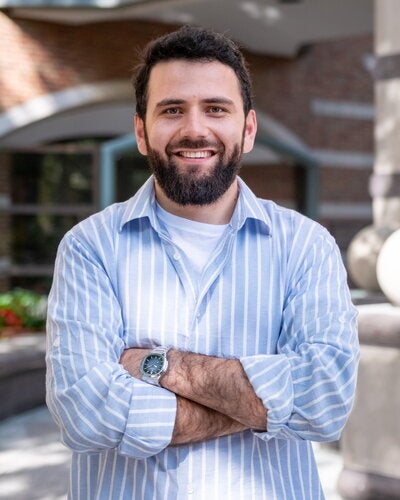
Muhammad Musozoda
Muhammad Musozoda is a third-year Ph.D. student in the Department of Chemistry at the University of Illinois Urbana-Champaign. In 2023, he graduated from Oswego State with a B.S. in chemistry and a minor in business administration, then earned his M.S. in chemistry in 2025.
Organic photovoltaics are solar cells that convert sunlight into electricity using organic semiconductor materials. Their molecular structures can be tuned, offering opportunities to develop lightweight, flexible and semitransparent photovoltaic devices. However, achieving both high performance and long-term operational stability remains a significant challenge.
Musozoda is using blocc chemistry, a modular synthesis platform developed by the Burke Lab wherein prefabricated bloccs are linked together in a repeating cycle through carbon–carbon bond formation. Musozoda is applying this approach to investigate the relationship between molecular sequence, efficiency of organic solar cells and photostability. The resulting structure–function relationships will be used to develop machine learning models for molecular design.
Musozoda is collaborating with Martin Burke, a May and Ving Lee professor of chemistry and biomedical and translational science, and Ying Diao, a professor of chemical and biomolecular engineering.

Kerui “Kerry” Xu
Kerry Xu is a sixth-year analytical chemistry Ph.D. student at Illinois. Xu graduated from the University of Illinois Urbana-Champaign with a B.S. in chemistry in 2020.
Alzheimer’s disease is a major neurodegenerative disease that affects a significant portion of people older than 65. Though the condition is complex and still not well understood, researchers have recently begun to focus on the beta-amyloid peptide as a major component of the neurotoxic plaques that cause Alzheimer’s disease.
Scientists now believe that amyloid-targeting agents may alleviate some of or potentially all the disease’s symptoms. Xu’s research seeks to study these agents closely using techniques such as two-photon microscopy. This technique makes it easier to find and analyze the correlation between plaque presence and metabolic changes that stem from releasing the plaque peptide-targeting agents into the body.
Xu currently collaborates with Liviu Mirica, a William H. and Janet G. Lycan professor of chemistry; molecular and cellular biology’s Daniel Llano; and Martha Gillette, a professor of cell and developmental biology.