Sometimes the chemistry just doesn't work no matter what you try. Nothing gets the results you need or want. Those are the days when chemistry graduate student Rachel Schaaf sits down at her desk and feels defeated. But then she looks at that little card.
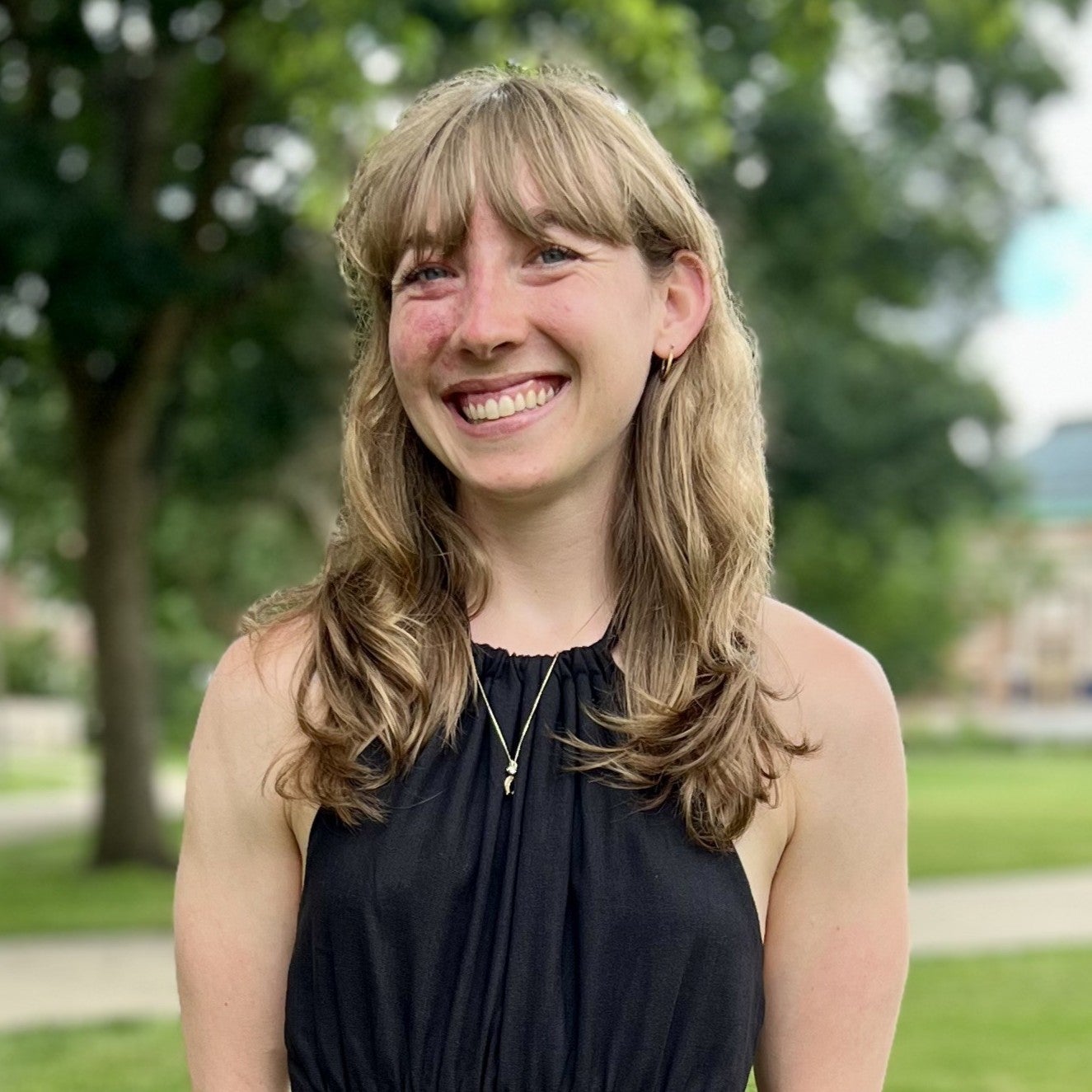
“I see his business card and remember why I'm doing this, and it just gives me that little extra motivation to say, okay, what is another avenue I can take,” said Rachel, who keeps her private track coach’s business card tacked to a bookshelf near her desk. “It's like my little reminder every day. He's looking down and I'm doing it for him.”
The athlete
A rising high school track star at The Hill School outside Philadelphia, Rachel’s best event was the triple jump. As a freshman she was jumping impressive distances of 37 feet and broke the school record. But at the end of that season, Rachel suffered a stress fracture in her lower left leg that set her back, literally.
“It was really hard for me to come back. I wasn't hitting the marks I was hitting as a freshman,” she said. “I was jumping two feet less than what I was jumping.”
Rachel thought about quitting.
“It was really hard. There were many times I almost quit track and field,” she said.
Then she met Ron Livers, a former U.S. Olympic athlete and private track coach. Livers told her she could come back from the injury and be better than ever. He told her she had potential to compete in college at the Division I level.
“He really was like, no, I really can see you getting better. You're going to hit your goals. You'll jump over 40 feet. You are going to get there. And I will help you get there. He really saw the potential in me,” Rachel said.
A three-time Pennsylvania state champion triple jumper, Livers had overcome injuries in his own career that included three NCAA titles in the triple jump and a national title in 1978. Livers made the U.S. Olympic Team in 1980 but saw his dream slip away with the American boycott of the Games that year.
With hard work and coaching from Livers, Rachel regained her form. By the end of her senior year, she had amassed numerous track and field honors, set both the indoor and outdoor triple jump record and earned multiple team MVP awards.
And then she achieved a goal Livers had predicted.
She went on to Colgate University to compete as a Division I track and field athlete. Triple jump was her main event, but she also competed in the long jump and anchored the team’s 4x100 and 4x400 relay teams and competed in the heptathlon.
Now, she was a rising Division I college star with hopes of reaching that next goal of surpassing 40 feet. But in December of her junior year at Colgate, Livers lost a two-year battle with brain cancer.
“I lost him my junior year of college, which was really tough for me,” said Rachel, who found a way to channel the grief. “I continued to compete for him.”
That year, she set a new Colgate record with a triple jump of 11.94 meters, just shy of the 40-foot mark Livers predicted she could reach.
The scholar
Rachel had always excelled in academics as well as athletics. With a love of math that began in first grade, she started Colgate as a math major with a dream of becoming a high school calculus teacher.
Then she took a chemistry class to fulfill an academic requirement.
“I was like, I've always loved chemistry. I'll take this class,” said Rachel, recalling how certain she was this would be her only chemistry class in college. “And that became the biggest lie I've ever told in my life.”
By her sophomore year, she was considering chemistry as a minor.
“I started taking organic chemistry and my friend on the track team joked that I was taking organic chemistry for fun. She wasn't entirely right, but she also wasn't entirely wrong,” Rachel said. “I just really enjoyed chemistry and wanted to learn, but that was the class that made me say, ‘I could be a chemistry major.’ ”
That spring, the pandemic changed everything. Rachel suddenly had more free time.
“I felt like I had more time to do schoolwork with COVID since a lot of things got cut out because of the pandemic. I said I think I can double major in math and chemistry,” Rachel recalled.
Her junior year, she was a double major in math and chemistry and her organic chemistry professor and advisor, Rick Geier, began encouraging her to consider graduate school.
That summer, Rachel got her first experience doing chemistry research in Geier’s lab and was truly convinced this would be her new path.
“I fell in love with doing research. I was like this is so much fun,” said Rachel, who was advised to apply to 8-10 chemistry graduate school programs.
By the time the outdoor track season rolled around in the spring of her senior year, Rachel had finished applying to nine chemistry graduate programs, including the University of Illinois-Urbana Champaign.
The elusive goal
With the graduate school application process behind her, Rachel was feeling a little less stress entering Spring break of her senior year and could devote more time and mental focus to her training, which paid off.
At the Alan Connie Shamrock Invitational in Myrtle Beach, S.C., Rachel broke her own Colgate triple jump record on one of her first jumps of the meet and recorded personal records on all six of her jumps. With Coach Livers’ initials written on her hand for motivation before each jump, she was hopeful to finally surpass her major goal of 40 feet.
On one of her last attempts in the triple jump final with her teammates and coaches watching and cheering on their senior captain, she soared beyond 40.
“I jumped 12.34 meters, which is such a fun number. That is exactly 40 feet 6 inches,” Rachel said. “It was just such a big moment for me that I can still remember a lot of the details.”
She wasn’t sad that she couldn’t share her amazing jump with her coach.
“Because I knew he was watching me the whole time,” Rachel said.
The why
As Rachel was choosing which graduate programs to apply to one of her Colgate chemistry professors acknowledged Rachel’s love of chemistry but then asked her why she really wanted to do chemistry. After seriously considering the question, Rachel said she was lying awake one night when it hit her.
“That's when I was like, my gosh, it's just been in front of me the whole time and I just never saw it. I want to see what I can do with brain cancer and organic chemistry,” Rachel said.
An internet search for brain cancer and chemistry introduced her to Prof. Paul Hergenrother’s research at Illinois.
“It was the last one I decided to apply to but was honestly the one I really wanted to go to in the end,” said Rachel, recounting the moment she found out she was accepted. “I was up in my bedroom, and I ran down to the family room where my mom and my brother were, and I was like ‘I got into Illinois.’ I was so excited because this was the work that I like really wanted to do. It was the work that I was so excited about.”
Now, a fourth-year graduate student in the Hergenrother lab, Rachel was selected earlier this year to receive an ACS Division of Medicinal Chemistry Predoctoral Fellowship, which recognizes outstanding predoctoral students engaged in medicinal chemistry research.
"I started to jump around I was so excited," Schaaf said describing the moment Hergenrother told her to check her email and she read the message telling her she had been selected.
The research that Schaaf is pursuing for the fellowship involves making kinase inhibitors, a class of drugs that block the action of enzymes called kinases and helps stop cancer cells from growing and spreading. Schaaf explained that kinase inhibitors have the ability to treat brain metastasis by adding a functional group that enables them to evade P-glycoprotein efflux (P-gp) at the blood brain barrier.
"That is the main efflux pump at the blood brain barrier and is one of the reasons that 98% of small molecule drugs are not blood brain barrier penetrating, because even if they can get in, a lot of them get effluxed out through this pump," Schaaf explained.
Her research is about helping those types of drugs avoid getting pumped out, and if they can successfully pass through the blood brain barrier, they can better treat brain metastasis.
Previous work in this area, Rachel explained, showed that adding a carboxylic acid is able to avoid the efflux problem, but often, that also limits permeability through the blood brain barrier.
“So I'm also looking at bioisosteres of carboxylic acids on scaffolds that are not drug related to see how that interacts with efflux to determine if we can find a different functional group that is able to better balance permeability and efflux,” said Rachel, who will present on this research as an ACS Medi-Fellow at the ACS National Meeting at Atlanta in March of next year.
The little reminder
Rachel said it means so much to her to receive the fellowship.
“It's like everything. I'm not sure I have the exact words to describe everything that it means to me. It rewards all of the hard work I've put into graduate school and all the passion I have for the work that I'm doing,” she said, adding that it makes her feel like someone who really can have an impact in medicinal chemistry. “Coming in, that’s what I wanted.”
Rachel said that is the underlying motivation – to make a real-world impact. And she has a real-world reminder for inspiration.
“That was actually my first decoration on my desk was his old business card, so I hang it up there every day. So, if I ever kind of question grad school or, you know, the imposter syndrome comes in and I question why I am here, it's like my little reminder every day,” she said. “He's looking down and I'm doing it for him.”