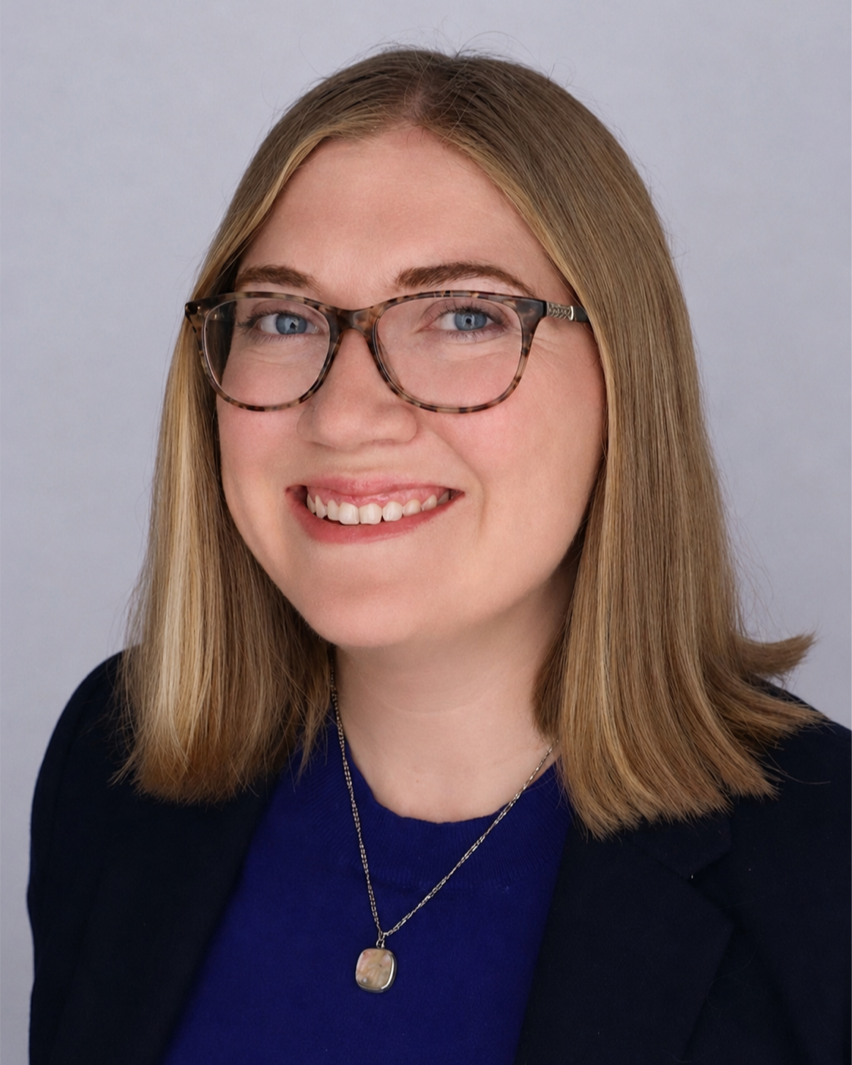
New Illinois chemistry faculty member Megan A. Steves comes to campus from the University of California - Berkeley where she was an Arnold O. Beckman Postdoctoral Scholar. Steves specializes in physical chemistry, but her interests also span biophysics and analytical chemistry. At Illinois, she will focus on developing new optical microscopy methods that push the limits of current technologies, allowing for faster imaging with richer chemical detail.
At Berkeley, Megan Steves worked on developing new methods to speed up single-molecule measurements for biological imaging. The research was a shift from her Ph.D. work at Penn State, where she was a National Science Foundation Graduate Research Fellow and studied the nonlinear optical properties of 2D materials.
“My interests have shifted, but my time at Penn State shaped how I approach science. I'm compelled by coming up with ways to study complex, multi-component systems, whether in biology or materials, to uncover the physical principles that govern how all those parts work together,” Steves said.
At Illinois, Steves will specifically focus on single-molecule spectroscopy and super-resolution microscopy.
“By watching an individual molecule or protein inside a living cell, we can learn a great deal about how different components are arranged, how they interact and move, and how they carry out their functions. These approaches also allow us to see things with details smaller than the wavelength of visible light, at resolutions under 10 nm,” she said.
Steves is particularly interested in how her research group might use new microscopy methods they develop to understand the chemistry of relatively weak biophysical interactions.
“These weak interactions are crucial for biology, allowing for dynamic responses to stimuli and fine-tuning cellular regulation, but they are intrinsically short-lived, making them challenging to study compared to more stable, stronger intermolecular interactions,” she said.
A native of southern New Jersey, about an hour outside Philadelphia, Steves started college as an art history major at Messiah University in Pennsylvania.
“After my first week I went to my academic advisor to complain that my classes weren't challenging enough. He suggested I take some chemistry classes to prepare for further studies in art conservation,” Steves said.
She took the advice and was hooked.
“I found that I really enjoyed the practical problem-solving of chemistry lab work as well as building an understanding of the fundamental science. I really credit the strength of the chemistry program at Messiah University for my decision to go to graduate school and ultimately pursue a career as a chemist,” she said.
Despite no prior connections to Illinois, Steves said she was quickly drawn to the Department of Chemistry at Illinois, especially to the interdisciplinary atmosphere and a strong presence in physical chemistry and microscopy. In addition to launching her research group and lab this fall, she will also be teaching CHEM 442 – Physical Chemistry I.
“I'm thrilled. Reaching the point where I can build a lab and a team to start testing the ideas I'm interested in is incredibly exciting,” Steves said. “I've spent a lot of time thinking about the questions I want to pursue in my independent career, but I'm eager to see how these plans evolve and where the science will take us when I have students join the group and we have a laboratory to start testing these ideas experimentally. I can't wait for the day a student brings me the results of an experiment and it's completely unexpected.”